You want to foster in Washington. Then you discovered that DCYF, WOTS, MERIT, and your Child Placing Agency all assume you already understand the other three.
Washington reorganized its entire child welfare system in 2018. The old DSHS playbook is gone. The new Department of Children, Youth, and Families runs foster care licensing through six regional offices, each with its own wait times, training availability, and licensor caseloads. The official timeline says 120 days from application to license. Community forums and the Office of the Family and Children's Ombuds tell a different story: six to nine months is common, and most of that delay is preventable.
You found the DCYF website. It tells you to complete Caregiver Core Training, pass a background check, and schedule a home study. It does not tell you that some Child Placing Agencies refuse to accept WOTS online training modules and require their own in-person cohorts instead -- meaning the 20 hours you spent on WOTS may not count if you chose the wrong licensing track. It does not tell you that the MERIT system was designed for childcare professionals, not foster parents, and that uploading your CPR card requires navigating a portal with no foster-specific instructions. It does not tell you that in Western Washington, where it rains eight months a year, surface mold in a bathroom can trigger a Correction Agreement that delays your license by months.
You found the WAC. Chapter 110-148 is the regulatory code governing foster home licensing. It runs hundreds of sections. It tells you what the state requires but never the order of operations as a family. Firearms storage, pool fencing, bedroom square footage, water temperature, medication lockboxes -- the requirements are there, scattered across dozens of subsections, with no checklist and no priority ranking for what licensors actually flag.
You found the agencies. Amara in Seattle. Olive Crest in Tacoma. Alliance CaRES statewide. Each one explains their pathway and their training schedule. None of them explain the DCYF direct pathway, the other agencies' requirements, or how costs and independence differ across tracks. Each one assumes you've already decided to go with them.
The DCYF Licensing Roadmap
This is a complete, Washington-specific foster care licensing guide built around the problem every family in this state hits: navigating a system where DCYF regional offices, Child Placing Agencies, the Washington Online Training System, MERIT, and the WAC 110-148 regulations each own a piece of the process but none of them explain how the pieces connect. Not a national overview. Not an agency recruitment brochure. Every chapter, every checklist, every payment figure is grounded in WAC 110-148, current DCYF policies, the seven-level Caregiver Support model, and the regional realities of fostering from Seattle to Spokane.
What's inside
- CCT Decision Matrix -- The single biggest source of wasted time in Washington foster care licensing. Caregiver Core Training is required, but the format depends on your licensing track. DCYF direct licenses accept WOTS online modules. Many CPAs like Amara and Olive Crest mandate their own in-person cohorts. Some accept a hybrid. This chapter maps every combination -- WOTS online versus classroom, CPA versus DCYF direct -- so you choose the right training format before investing 20 hours in modules your agency won't accept. Includes the CPR/First Aid and Bloodborne Pathogens requirements and which providers are approved statewide.
- WA Moisture Audit checklist -- Washington's wet climate is the invisible gatekeeper of the foster care system. WAC 110-148-1440 requires homes to be clean, safe, and sanitary, but the code doesn't distinguish between cleanable surface mold in a bathroom and structural moisture damage that requires professional remediation. In Western Washington, where homes from Bellingham to Olympia sit in persistent dampness from October through April, mold is the most common unexpected reason for inspection failure. This chapter provides a room-by-room pre-inspection moisture checklist based on actual licensor feedback, explains what triggers a Correction Agreement versus what passes, and covers ventilation, crawl space, and attic moisture barriers so your inspection is one-and-done.
- ICWA and WSICWA plain-language guide -- Washington has 29 federally recognized tribes. Many of the children entering foster care are protected by the Indian Child Welfare Act and Washington's own WSICWA statute, which sets a higher standard than federal law. Parents worry that a tribal placement preference means the child can be removed without warning. That fear is based on misunderstanding, not law. This chapter provides a plain-language explanation of Active Efforts, Placement Preferences, and Qualified Expert Witness requirements under both ICWA and WSICWA, so you can be a confident advocate for the child in your care while supporting their cultural connections.
- BRS versus Regular Support Levels payment breakdown -- Washington uses a seven-level Caregiver Support model. Level 1 pays $722 per month for children ages 0-5. Level 3 adds $685 in support payments for a total of $1,407. Level 5 reaches $2,092. Level 7 reaches $2,777. But Behavioral Rehabilitative Services is a separate track entirely -- children with high-intensity therapeutic needs placed through specialized CPAs, often reimbursed on a daily pro-rated basis with higher training requirements. This chapter breaks down all seven levels, explains BRS eligibility and oversight, and helps you determine which level of care you're realistically equipped to provide before you get a placement call at 11 PM asking you to decide in 30 minutes.
- Regional Response Guide for DCYF Regions 1 through 6 -- The DCYF website implies the licensing process is the same statewide. It is not. Region 4 (King County) has vastly different wait times and training availability than Region 1 (Spokane) or Region 2 (Yakima). Rural eastern Washington licensors carry different caseloads than the metro Puget Sound offices. This chapter provides region-specific contact information, typical processing timelines, and follow-up strategies for each of the six DCYF regions so you know who to call, when to call, and how to be "pleasantly persistent" without damaging your relationship with your licensing team.
- Safety requirements decoder -- WAC 110-148 sections 1320 through 1440 contain the physical home requirements. Firearms must be stored in a locked container separate from ammunition. Pools, hot tubs, and trampolines require specific fencing and covers. Bedrooms need minimum square footage per child. Water heaters must be set below 120 degrees. Medications require a lockbox. Cleaning chemicals must be stored out of reach. This chapter consolidates every physical safety requirement into a single walkthrough checklist organized room by room, with the five non-negotiables that licensors flag most frequently highlighted so you fix them before the inspection, not after.
- WOTS and MERIT navigation guide -- The Washington Online Training System and MERIT are the state's digital infrastructure for foster parent training and credential tracking. Both were designed for childcare professionals. Neither has a foster-parent-specific user guide. This chapter provides step-by-step navigation for creating your accounts, enrolling in required modules, uploading completion certificates, and troubleshooting the most common errors that cause parents to lose a Saturday trying to figure out why their CPR card won't upload.
- CPA versus DCYF direct licensing comparison -- The biggest structural decision you'll make. Licensing directly through DCYF gives you more independence and flexibility in placements. Licensing through a CPA like Amara, Olive Crest, or Alliance CaRES gives you more hands-on support, mentorship, and often faster initial training placement. But CPA parents are subject to that agency's specific training, placement rules, and support expectations. This chapter compares both tracks side by side -- costs, training requirements, placement control, support levels, and the realistic pros and cons of each -- so you choose the right structure before you're locked into a pathway.
Who this guide is for
- Seattle and King County families navigating the Region 4 backlog -- You live in the densest, most expensive housing market in the state. Your home may be a 1,200-square-foot condo or a house with a detached ADU. You've heard Region 4 has the longest wait times. This guide maps the Region 4 licensing reality and the safety requirements that apply to smaller urban homes so your square footage doesn't become a surprise disqualifier.
- Military families at Joint Base Lewis-McChord -- You're stationed at JBLM in Pierce County. Your next PCS could come before your license is finalized. This guide covers the Interstate Compact on the Placement of Children, how to maintain your licensing status across moves, and how to time the process around your military schedule.
- Rural eastern Washington families -- You're in Spokane, the Tri-Cities, Yakima, or Wenatchee. Your property has a well, livestock, or acreage. The licensing requirements for rural homes -- well water testing, firearms storage for hunting families, and the reality of being 90 minutes from the nearest CPA office -- are different from what the Seattle-centric DCYF materials describe. This guide covers Region 1 and Region 2 specifics.
- Kinship caregivers who need legal standing -- You've been raising your grandchild, niece, or nephew. You lack a foster care license, which means you lack access to the monthly support payments and Medicaid coverage the child is entitled to. This guide covers the kinship licensing pathway, the expedited process for relatives, and the financial support available once you're licensed.
- Single foster parents -- Washington permits single adults to foster. The home study process is the same, but the questions are different. This guide addresses the specific home study dynamics for single applicants, including how licensors evaluate your support network and backup care plan.
- Families considering foster-to-adopt -- You want to adopt, and you've been told fostering first is the path. This guide explains the legal distinction between fostering and adoption in Washington, the reunification-first culture at DCYF, and how the transition from foster license to adoption petition works when reunification is ruled out.
Why the free resources aren't enough
The DCYF website covers the broad strokes. It lists requirements, links to WAC 110-148, and directs you to orientation sessions. It does not explain that WOTS online training may not be accepted by your chosen CPA. It does not distinguish between surface mold that passes inspection and moisture damage that triggers a Correction Agreement. It does not explain that Region 4 processing times bear no resemblance to Region 1 timelines. And it does not cover BRS, the seven-level payment model, or how to evaluate whether you're equipped for therapeutic-level care before accepting a placement.
Agency websites explain their pathway. Amara covers Amara. Olive Crest covers Olive Crest. Alliance CaRES covers Alliance CaRES. None of them explain the DCYF direct pathway, the other agencies' training requirements, or how your choice of agency affects your independence, placement control, and long-term relationship with the licensing system.
The WAC is public law. All 110-148 sections are available on leg.wa.gov. Reading them without a guide is like reading the building code to figure out how to remodel your kitchen. The information is there. The sequence, the priorities, and the practical interpretation are not.
National foster care books reference "state requirements" and "home studies" without addressing Washington's DCYF structure, the WOTS/MERIT digital systems, the CCT format conflict between agencies, or the Pacific Northwest moisture reality that affects half the homes in the western part of the state.
Printable standalone worksheets included
The guide comes with printable standalone PDFs designed for real-world use:
- Home Safety Walkthrough -- Every WAC 110-148 physical requirement organized room by room. Firearms, pools, medications, water temperature, bedroom dimensions, smoke detectors, carbon monoxide alarms. Walk through your home with this checklist before the licensor does.
- Background Check Tracker -- WSP fingerprints, FBI clearance, DCYF Central Registry, sex offender registry, and out-of-state abuse registry checks for every household member over 16. Submit dates, follow-up dates, and the timeline that prevents your clearances from expiring before your home study is complete.
- Training Completion Log -- CCT hours, CPR/First Aid, Bloodborne Pathogens, and any agency-specific training requirements. Track completion dates, certificate uploads to MERIT, and renewal deadlines so nothing lapses.
- Moisture Pre-Inspection Checklist -- A room-by-room walkthrough for Western Washington homes. Bathroom ventilation, crawl space moisture barriers, attic condensation, window condensation, and the exterior drainage issues that licensors flag. Fix them before the inspection, not after the Correction Agreement.
The free Quick-Start Checklist
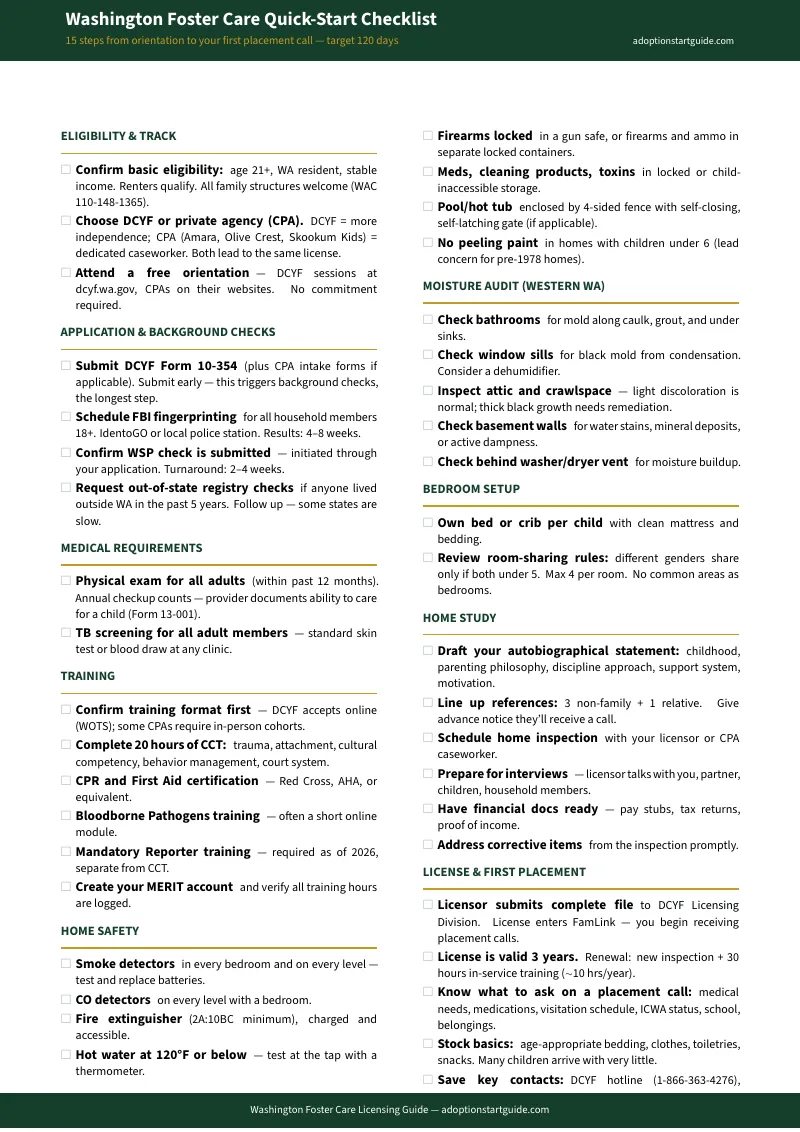
Download the Washington Foster Care Quick-Start Checklist for a one-page overview of the key steps from first inquiry to licensed home. Free, no commitment. If you want the full guide with the CCT Decision Matrix, the WA Moisture Audit, the ICWA plain-language guide, the BRS payment breakdown, the Regional Response Guide, and all the printable worksheets, click the button in the sidebar.
-- less than one hour of a foster care consultant's time
Private foster care consultants in Washington charge $50 to $100 per hour. Families routinely spend their first session covering foundational questions this guide answers in Chapter 1. A single month of licensing delay costs you $722 to $860 in support payments you're not receiving while a child sleeps in an office because there aren't enough licensed beds. The DCYF Licensing Roadmap doesn't replace your agency or your licensor. It makes sure you don't waste their time -- or yours -- on preventable mistakes that push your 120-day timeline to nine months.