
You Want to Foster a Child in West Virginia. The System Wants You to Figure It Out Alone.
West Virginia needs foster parents more urgently than almost any other state in America. The opioid epidemic pushed the foster care population to nearly double between 2013 and 2019. One in eight babies born in West Virginia is substance-exposed — the highest NAS rate in the nation. Licensed foster homes are averaging 2.2 children each. Children have slept in DHHR offices because there simply weren't enough beds.
You've seen what's happening in your community. Maybe it's a neighbor's child, a church announcement, or a story on the news. You want to help. But when you look into it, here's what you find:
- The Bureau for Social Services website gives you regulations, not a roadmap
- Your district office takes weeks to return calls — if they call back at all
- PRIDE training in your area only runs a few times a year, and nobody told you the schedule
- You don't know if your well water, your septic system, or your older farmhouse will pass inspection
- You're worried about caring for a baby going through drug withdrawal, and the state's brochures don't prepare you for it
The free resources are compliance checklists. They tell you what the state requires. They don't tell you how to actually navigate a system that's understaffed, overwhelmed, and spread across 10 districts with varying levels of responsiveness.
The Mountain State Licensing System — Your Complete Guide to Getting Licensed Without the Runaround
This guide was built specifically for West Virginia's unique foster care landscape — the opioid crisis context, the rural property challenges, and the BSS bureaucracy that prospective parents have to navigate. It takes every step of the licensing process and translates it from regulatory language into clear, actionable instructions with the practical details the state doesn't provide.
What's Inside
The 14-Step BCF Licensing Process — Mapped and Decoded
Every step from your first phone call to receiving your license, with the exact documents you need at each stage, the timeline to expect, and the specific steps where applications get stuck. You'll know what comes next before your caseworker tells you — because sometimes they don't.
PRIDE Training Strategy for Rural Districts
PRIDE is the mandatory 27-hour pre-service training that every West Virginia foster parent must complete. In rural districts, cohorts may only run quarterly. Miss one, and your license is delayed by months. The guide includes the proactive enrollment script to secure your seat immediately and instructions for checking neighboring districts if your area's schedule doesn't work.
NAS Infant Care — The Eat, Sleep, Console Method
With 14% of West Virginia infants born substance-exposed, the probability that you'll care for a baby in withdrawal is high. This chapter translates the clinical ESC protocol into practical home-based strategies: swaddling technique that reduces tremors, clustered care scheduling that protects fragile sleep cycles, sensory reduction setup, and rhythmic rocking at the right pace. You'll understand what the first weeks look like, what's normal, and when to call for help. This is the chapter that transforms fear into competence.
Rural Home Inspection — The Pre-Inspection Readiness System
Your house doesn't need to be new. BCF is looking for safe, not perfect. But the environmental health standards catch rural families off guard. The guide covers the well water bacteriological test, the septic system dye test, the SG-55 form you'll need from the county health department, the fees involved, and the bedroom and safety requirements under CSR 78-2. You'll have the complete pre-inspection checklist so your first visit from the sanitarian passes.
The BSS Self-Advocacy System
West Virginia's caseworker turnover is well-documented. Workers change, applications sit, and nobody follows up unless you do. The guide provides direct contact information for all 10 BSS districts, district manager names, follow-up scripts for when your application stalls, and the documentation log template to maintain continuity when your assigned worker leaves.
Sibling Group Capacity Planning
With an average of 2.2 children per licensed home, you will likely be asked to take sibling groups. The guide walks you through the spatial math of West Virginia's bedroom requirements — maximum four children per room, individual beds only, no opposite-sex sharing — with capacity planning examples for different home sizes. Equally important: how to communicate your limits clearly so you get the right placements for your family.
Kinship Care and the RAPP Program
If you're a grandparent, aunt, uncle, or family friend stepping in for a child in your circle, the licensing path is different. The guide covers the RAPP (Relatives as Parents) program, streamlined kinship licensing standards, the financial gap between licensed and unlicensed kinship care, and what to do if a child is already in your home.
Financial Reality — Rates, Coverage, and Hidden Costs
Monthly maintenance rates by age group, enhanced rates for specialized placements, Medicaid coverage for every foster child, child care assistance, and an honest breakdown of the hidden costs nobody mentions — home repairs to pass inspection, gas money for training in distant districts, and time away from work for interviews.
Foster-to-Adopt Pathway
If your goal is adoption, the guide covers how concurrent planning works in West Virginia, the ASFA timelines that govern when the state must pursue permanency, the Termination of Parental Rights process, adoption finalization, and adoption assistance that continues after the legal process is complete.
Plus: Legal Protections, Support Organizations, and Appendices
Your rights under the Foster Parent Bill of Rights (WV Code Section 49-2-127), the master document checklist, placement call checklist, and the complete BSS district contact directory.
Who This Guide Is For
- First-time prospective foster parents who want a clear roadmap before contacting BSS — especially in rural districts where the process feels opaque
- Kinship caregivers who received a call or are already caring for a relative's child and need to understand the RAPP program and licensing path
- Families preparing for infant placements who want practical NAS care preparation, not just a brochure
- Rural homeowners worried about whether their well water, septic system, or older home will pass inspection
- Anyone whose application stalled — your worker left, BSS stopped calling, or you missed a PRIDE cohort and need to get back on track
- Foster-to-adopt families who want to understand the legal timeline from foster care to permanent placement
Why This Exists When There Are Free Resources
Free resources from BSS and organizations like Mission West Virginia do the important work of recruitment and providing the basic regulatory framework. But they leave five critical gaps:
- NAS infant care preparation. The state mentions "substance exposure" but doesn't teach you the Eat, Sleep, Console method or how to set up your home as a low-stimulation sanctuary for a withdrawing baby.
- Rural property inspection navigation. Free guides say you need a home inspection. They don't explain the SG-55 form, the septic dye test, the well water bacteriological analysis, or the county health department fees.
- BSS district responsiveness. Free resources provide a general contact list. They don't give you follow-up scripts, district manager contacts, or strategies for self-advocacy in an understaffed system.
- Sibling group capacity planning. With an overcrowded system, you'll face pressure to take more children than planned. Free resources don't teach the spatial math or the boundary-setting conversations.
- PRIDE training logistics. Free resources point to a calendar that may be outdated. This guide gives you the proactive approach to enrollment that prevents a six-month delay.
This guide fills those gaps with the operational detail that turns a willing heart into a licensed, prepared foster parent.
Your Investment
For , you get the complete West Virginia Foster Care Licensing Guide — the 14-step process decoded, NAS infant care preparation, rural home inspection checklist, BSS district directory with follow-up scripts, and every template and tool you need from first call to first placement.
A failed well water test costs $50 to retest. A missed PRIDE cohort delays your license by months. A single call to the wrong district office wastes weeks. The guide pays for itself the first time it saves you from one of these setbacks.
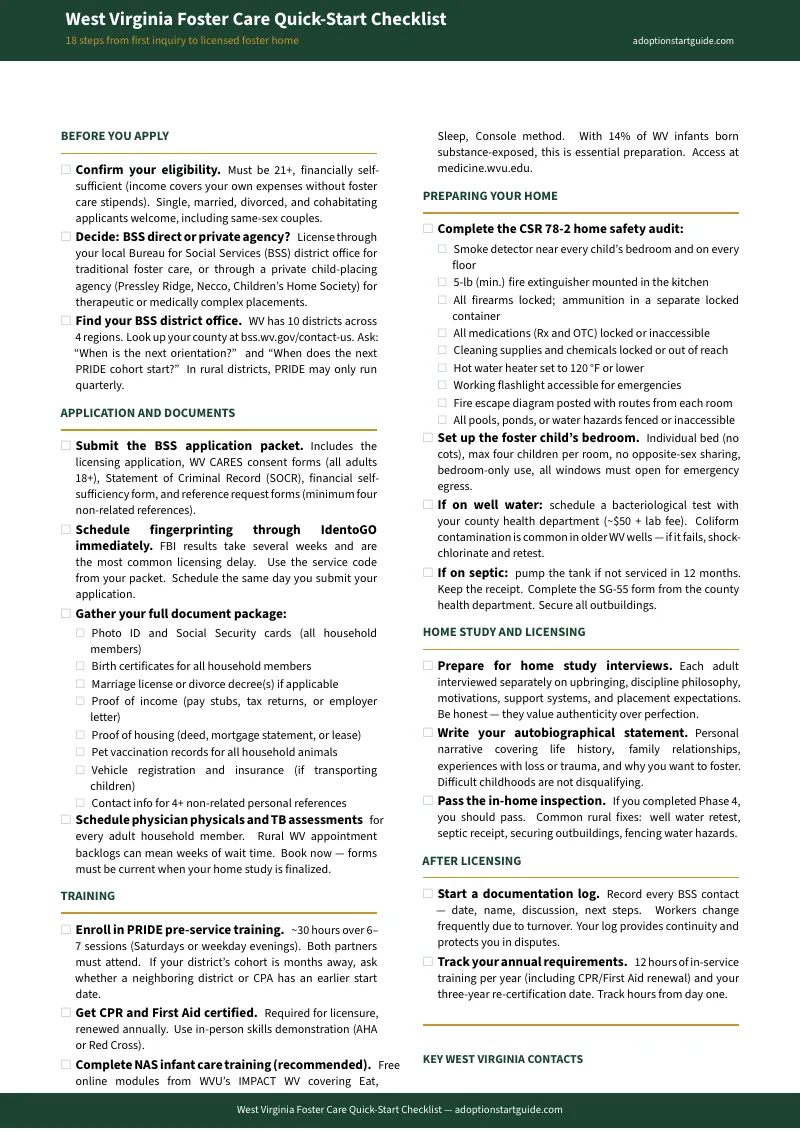
Start with the free checklist — 18 actionable items organized across five phases of the licensing process. If you want the complete system with NAS care protocols, BSS contact directory, rural inspection preparation, and all the templates, get the full guide.