
You're already caring for the child. The government still treats you like a stranger.
The child has been sleeping in your house for months. Maybe years. You're the gogo who took in your daughter's children after she passed. You're the aunt who got the call from the neighbour. You're the uncle who drove to the police station at midnight. The child is fed, the child is safe, the child calls your house home. But without a Children's Court order, you have no legal standing, no access to the Foster Child Grant, and no guarantee that the placement you've been funding out of your own pocket will survive a bureaucratic review.
So you went to the DSD office. You waited in the queue. You were told to come back with a police clearance, a Form 30 application, the child's unabridged birth certificate, proof of income, and a social worker report. When you asked how long it takes, the clerk said "it depends." When you asked which social worker would be assigned, she said "we'll contact you." That was three months ago. Nobody has contacted you.
Then you tried the DSD and SASSA websites. You found the Children's Act. You found the grant amounts. You found a phone number for your provincial office that rings and rings. What you didn't find was the part where someone tells you: here is what to do this week, in this order, with these exact documents, at this specific office, and here is how long it will actually take.
You asked in the Facebook groups. Foster Care South Africa. Grandparents Caring for Grandchildren SA. You got encouragement. You got horror stories about lost files and court dates postponed four times. You got told to "just go to SASSA and explain." Nobody could tell you whether to pursue the Foster Child Grant at R1,290 per month or take the CSG Top-Up at R870 and skip the court process entirely. Nobody could explain what the difference means for the child's education after age 18. Nobody mentioned that the wrong choice could cost you R420 per month per child for the next decade.
The Court-Ready System
This guide is built for the South African foster care system and nobody else's. Every chapter, every form reference, every contact, every rand amount is grounded in the Children's Act 38 of 2005, the Children's Amendment Act 17 of 2022, current SASSA grant rates, and the operational reality of a system where social workers carry caseloads of 1:94 and Children's Courts have multi-year backlogs. It covers the gap between what the DSD publishes online and what you actually need to know to get from "caring informally" to "legally recognised foster parent with the grant deposited monthly" without a rejected Form 30, a lapsed court order, or years of silence from a system running on fumes.
What's inside
- FCG vs CSG Top-Up Decision Framework — The single most consequential financial decision you'll make as a kinship caregiver. The Foster Child Grant pays R1,290 per month with no means test but requires a court order and biennial renewals. The CSG Top-Up pays R870 per month, has a means test, but processes through SASSA in weeks with no court involvement and no renewals. For three children, the difference is R1,260 per month. This chapter gives you the decision matrix: your income, the child's age, whether they'll need the Section 176 educational extension to age 21, and what happens if a court order lapses. You'll know which path is right before you queue at any office.
- Form 30 Accelerator — The Child Protection Register check is your first administrative bottleneck. DSD offices routinely take 3 to 6 months to process Form 30 because it requires national-level clearance. This chapter explains how to submit your Form 30 application on day one, before you even have a social worker assigned, so the clearance runs in parallel with every other step instead of holding up your entire timeline.
- Police Clearance Navigator — The Police Clearance Certificate costs R190 per adult in the household and takes 2 to 8 weeks. Many caregivers delay because they fear a decades-old arrest or a minor offence will disqualify them. It won't. This chapter explains what actually triggers rejection, what the magistrate evaluates in borderline cases, and how to submit at your nearest SAPS station with the correct form on the first visit.
- Children's Court Survival Guide — South Africa has 300,000 lapsed foster care court orders. The backlog is not an accident — it's a structural feature of a system with too few social workers and too many cases. This chapter explains the court hearing itself: who must attend, what the magistrate asks, what documents your social worker must file, what happens when a hearing is postponed (and it will be), and how the Children's Amendment Act 17 of 2022 now allows presiding officers to extend lapsed orders by six months at a time so your grant doesn't get cut while the system catches up.
- Court Order Renewal System — A standard foster care order expires after two years. If you don't initiate the renewal process 3 to 4 months before expiry, SASSA will terminate your grant. This chapter gives you the renewal timeline, the documents your social worker needs to file, and what to do if your social worker has left the DSD and nobody has been reassigned — because that happens constantly.
- Provincial DSD Office Directory — Nine provinces, nine different levels of capacity, nine different queue realities. Gauteng processes faster than Limpopo. The Western Cape has more designated Child Protection Organisations. KwaZulu-Natal has the highest caseloads in the country. This chapter maps the provincial offices with phone numbers, physical addresses, and the CPOs operating in each province so you know exactly where to go and who can help.
- Home Assessment Preparation — The social worker will visit your home to assess safety, sleeping arrangements, hygiene, and your household's attitude toward the child. Many caregivers in townships and rural areas fear their home will be judged inadequate because it's small or basic. The assessment is not about wealth. This chapter explains what the social worker is actually evaluating, what Section 181 "fit and proper" means in practice, and how to prepare your home so the visit confirms what's already true: you're providing a safe and loving environment.
- SASSA Grant Application Walkthrough — Once you have the court order, you must apply at SASSA in person with original documents: the court order, your smart ID, the child's unabridged birth certificate, school attendance letter or clinic card, and proof of marital status. Missing one document means another trip. This chapter lists every document, explains the biometric registration process, and tells you that the grant backdates to the date the court order was issued — so every month the court process drags is a month of backpay you'll eventually receive.
- Section 176 Educational Extension — If a foster child turns 18 while still in school or starting tertiary education, the foster care order and the R1,290 monthly grant can be extended to age 21. The CSG Top-Up cannot. This is the single biggest long-term advantage of the formal foster care pathway. This chapter explains the Section 176 application: when to file (at least 90 days before the child's 18th birthday), where to file (provincial DSD), and what documentation the child needs.
- Kinship Care Considerations — You didn't choose to become a foster parent. A child in your family needed someone, and you were that someone. This chapter addresses the specific legal, financial, and emotional realities of relative caregivers: how the CSG Top-Up was designed for you, when formal foster care still makes sense for kinship placements, and how the Children's Amendment Act now allows long-term kinship orders valid until the child turns 18 without intensive biennial court reviews.
- The Foster-to-Adoption Pathway — If the child has been in your care for years and reunification with the biological parents is not possible, adoption may provide permanent legal security. This chapter explains the legal steps to convert a foster care placement into a full adoption under the Children's Act, including the role of the curator ad litem, the consent requirements, and the CPO fee structures under Regulation 107.
- Private Social Workers — If the DSD queue is months long and you can afford to pay, a private social worker registered with the SACSSP can conduct your home study, compile your court report, and manage your case at professional rates averaging R500 per hour. This chapter explains when private practitioners are worth the cost, what the Regulation 107 fee guidelines look like for subsidised CPOs, and how to verify registration before you pay.
Printable standalone worksheets included
- Required Documents Checklist — Every document you need organised by stage: before your first DSD visit, for vetting, for the court hearing, and for the SASSA grant application. Print it. Gather everything before you queue.
- Court Order Renewal Tracker — A timeline worksheet to track your two-year court order cycle, renewal deadlines, social worker contact attempts, and SASSA payment status. Prevents the lapsed-order crisis that cuts off grants for hundreds of thousands of caregivers.
- FCG vs CSG Top-Up Comparison Worksheet — Side-by-side financial comparison for your specific situation: number of children, ages, income, education plans. Fill it in and the answer becomes obvious.
- Home Assessment Preparation Checklist — Room-by-room walkthrough of what the social worker evaluates. Fix what you can before the visit. Most issues are low-cost and take an afternoon.
- Care Team Contact Sheet — DSD caseworker, CPO social worker, SASSA branch, child's school principal, clinic, legal aid contact, and crisis line numbers — all on one printable page.
- Monthly Budget Planner for Foster Families — Track how the foster care grant is spent on the child's needs: food, school fees, transport, clothing, medical. Required for social worker reviews and useful evidence if a grant review is ever questioned.
Who this guide is for
- Gogos and grandparents who are already raising the children — Your grandchild has been living with you since their mother passed or since she left for Johannesburg to find work. You've been surviving on the Child Support Grant or nothing at all. You don't know whether to apply for foster care through the court or take the CSG Top-Up. You need someone to lay out both paths in plain language and tell you which one fits your situation.
- Aunts, uncles, and relatives who got the call — A child in your family was removed by a social worker or left with you by a parent who couldn't cope. The child is in your house. You need to formalise the arrangement before something goes wrong — a medical emergency where you can't consent to treatment, a school that won't release records, a SASSA office that won't process a grant without a court order.
- Community members and non-relative foster parents — You've seen the children in your community who need stable homes. You want to foster but you've never interacted with the DSD and the process seems designed to discourage you. This guide shows you the full pathway from first enquiry to approved placement.
- Middle-class families considering foster care or foster-to-adopt — You have the resources and the stability. You're considering a private social worker to move faster. You need to understand the legal framework, the cost structure, and the realistic timeline before committing.
- Social workers and CPO staff looking for a client-facing resource — You're overwhelmed. Your caseload is double what it should be. You need something you can hand to a prospective foster parent that answers the first 50 questions so they arrive at your office prepared and informed.
Why the free resources fall short
The DSD website tells you what the Children's Act says. It does not tell you that Form 30 processing takes 3 to 6 months, that your social worker may carry 94 active cases and won't return your call for weeks, or that the Children's Court in your district has a backlog measured in years. It gives you the law. It doesn't give you the operational reality of navigating a system that processed 300,000 lapsed court orders and is still recovering.
The SASSA website lists grant amounts and eligibility criteria. It does not explain the FCG vs CSG Top-Up decision, the Section 176 educational extension that could fund your foster child's university fees until age 21, or what happens to your grant when a court order lapses because nobody told you to start the renewal four months early.
The CPO pamphlets from Child Welfare SA, ACVV, and Badisa are recruitment material. They describe their services and invite you to contact them. They don't mention the Regulation 107 fee schedules, the waiting lists, or the provinces where CPO coverage is so thin that the DSD local office is your only option.
The Facebook groups — Foster Care South Africa, Grandparents Caring for Grandchildren SA, Fostering in SA — are the closest thing to real operational knowledge. Caregivers share which SASSA branches are offline, which DSD offices lose files, and which courts postpone indefinitely. But the information is scattered across thousands of posts, contradicts itself weekly, and is dominated by frustrated caregivers venting about a broken system. A prospective foster parent reading those threads gets the impression that the process is impossible. It isn't impossible. It's poorly documented.
The free Quick-Start Checklist
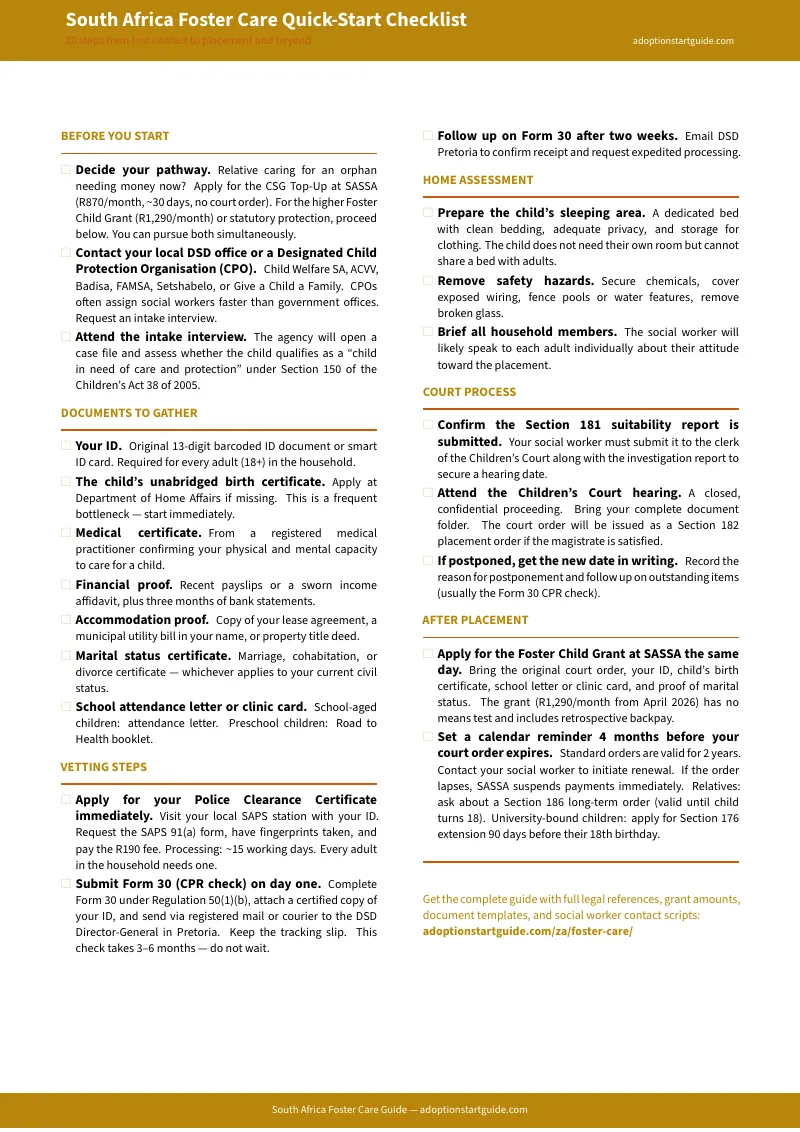
Download the South Africa Foster Care Quick-Start Checklist for a phase-by-phase overview of the process, from your first DSD visit through to your first SASSA grant payment. Free, no commitment. If you want the full guide with the FCG vs CSG Top-Up decision framework, the Form 30 Accelerator, the provincial DSD directory, the Children's Court survival guide, the Section 176 educational extension walkthrough, and all six printable worksheets, click the button in the sidebar.
— Less Than One Month's Grant Difference
The difference between the Foster Child Grant and the CSG Top-Up is R420 per month per child. For three children, that's R1,260 every month — R15,120 every year. Choosing the wrong pathway because nobody explained the trade-offs doesn't just cost money. It costs the child's educational extension rights at age 18. It costs you years of court renewals you didn't need or years of lost income you could have claimed.
This guide pays for itself before the first grant payment arrives.
If the guide doesn't deliver, reply to your download email at any time for a full refund. No forms. No justification required.