
South Africa finalises roughly 1,100 adoptions a year. More than 306,000 children are in foster care. The gap between families who want to adopt and children who need homes is not caused by a shortage of either. It is caused by a system where the DSD website gives you the law but not the process, agencies give you their process but not the alternatives, and Facebook groups give you everyone's opinion but nobody's verified facts.
You decided to adopt. Maybe you have spent years and tens of thousands of rands on fertility treatments that did not work, and you are ready for a different path. Maybe you and your partner are a same-sex couple who know the law is on your side but have heard stories about individual social workers who are not. Maybe you are a single person who has been told — incorrectly — that you cannot adopt alone. Maybe your foster child has been in your care for two years and you want to make it permanent before the system moves them. Maybe you have been looking at the RACAP register for months and wondering whether your name will ever come up.
Whatever brought you here, you went to dsd.gov.za looking for answers. What you found was a policy overview that explains the Children's Act 38 of 2005 in broad strokes but does not tell you which agency operates in your province, how much you will actually pay, what happens during the Section 231 assessment, or how long the RACAP wait really takes for your specific matching profile. It tells you to contact your provincial DSD office. It does not mention that those offices are understaffed, that wait times vary dramatically between Gauteng, the Western Cape, and KZN, or that government-facilitated adoption is free but can take years longer than a private agency.
So you turned to Facebook. "Adoption South Africa." "Adopting in SA." "SA Adoptive Families." You posted your question and received forty contradictory answers — someone in Johannesburg said Abba charges R25,000, someone in Cape Town said Wandisa charges R40,000, someone else said their cousin adopted through the government for free. A poster warned that transracial adoption is "practically impossible" (it accounts for 40% of all finalisations). Another claimed the 60-day consent window means the birth mother can take the baby back at any time (she cannot — after 60 days, consent is final and irrevocable). You spent three hours reading and ended up more confused than when you started.
Meanwhile, an Abba orientation session costs R305 per hour. A private agency domestic adoption runs R17,000 to R50,000. A family attorney charges R1,500 to R3,000 per hour for adoption-related work. These are professionals doing important work. But if you need the entire landscape explained before you even know which questions to ask your social worker — you do not need a R50,000 agency commitment. You need the complete picture first.
The Adoption Clarity System
This guide is built for South Africa's adoption framework and nobody else's. Every chapter, every checklist, every legal reference is grounded in the Children's Act 38 of 2005, the Children's Amendment Act 17 of 2022, the RACAP guidelines under Section 228, Regulation 107 fee schedules, and the operational realities of a country where the 60-day consent period, the Section 231 "fit and proper" assessment, and provincial court backlogs create a process that generic adoption advice routinely gets wrong.
What's inside
- Children's Act 38 of 2005 — decoded for parents, not lawyers — The Act is 310 pages of legal text. This chapter extracts the sections that directly affect your adoption: Section 7 (best interests standard), Section 228 (RACAP), Section 231 (who can adopt), Section 233 (consent), and the critical 2022 Amendment that expanded Children's Court jurisdiction over guardianship matters. You will understand your rights, your obligations, and the court's decision-making framework without needing a law degree.
- Section 231 Assessment — how to prepare so you pass on the first attempt — The social worker is not your adversary. But the assessment covers your motivation, emotional readiness, relationship stability, health, finances, criminal history, and support network — and most families walk in without knowing what "fit and proper" actually evaluates. This chapter walks you through every component: what the social worker is looking for during home visits, how to handle the psychological evaluation, why your financial status cannot legally disqualify you, and the exact documents to have ready (police clearance, Form 30, medical certificates) so the process takes three months instead of six.
- RACAP register — realistic wait times based on your matching profile — RACAP is not a first-come-first-served queue. A family open to transracial placement waits 1 to 3 years. A family seeking a healthy infant of a specific race waits 2 to 5 years. A family open to older children or children with special needs may be matched within 6 to 12 months. This chapter explains exactly how the matching algorithm works, what factors you control, and what the register's historical processing delays mean for your timeline.
- Agency comparison — Abba, JCW, Wandisa, Impilo, Child Welfare Durban, ACVV — Not all agencies operate in all provinces, and their wait times, preparation programmes, and fee structures vary significantly. This chapter compares the major accredited agencies across Gauteng, the Western Cape, and KwaZulu-Natal so you choose based on facts — which agency has offices in your region, how many adoptions they finalised last year, what their total costs actually are — instead of whichever name appeared first in a Google search.
- Full cost breakdown — Regulation 107 fees and the real total — The statutory fees look modest: R305 per hour for counselling, R609 for the home study report. The actual cost of a private domestic adoption runs R17,000 to R50,000 when you add agency professional fees, medical screenings (R1,050 for infant PCR tests), birth mother residential support (R1,000 to R3,000), court attendance, and courier fees for police clearances. Government adoption is free — but wait times are dramatically longer. This chapter gives you the complete financial picture so you budget accurately for your chosen pathway.
- The 60-day consent timeline — when adoption becomes irrevocable — After a birth parent signs consent before a presiding officer, they have 60 calendar days to withdraw without providing a reason. During those 60 days, the court cannot issue a final adoption order. After day 60, consent is permanent. This chapter maps the exact legal sequence, explains the abandonment procedure when parents cannot be found, covers unmarried father consent rules, and addresses the emotional reality of living through 60 days of uncertainty.
- Transracial adoption — navigating the 40% reality — Four in ten South African adoptions cross racial lines. The law does not prohibit it, but the RACAP guidelines include cultural identity considerations, and some social workers or magistrates prefer same-race placement. This chapter explains the legal position, the practical reality of "street-level" resistance, how to prepare for transracial parenting (cultural education, diverse environments, honest conversations), and your rights if you encounter bias during the process.
- Court process and documentation — The Children's Court hearing is typically 30 minutes to an hour, but the dossier your social worker prepares contains eight to ten documents that must be complete, verified, and correctly filed. This chapter covers every item — the social worker's report, the Provincial Head of Social Development recommendation, consent forms, RACAP confirmation, Form 30, medical reports, the child's birth certificate — and explains what happens if the court appoints a curator ad litem.
- Document checklist — Every document you need, organised by phase: assessment preparation (ID, marriage certificate, police clearance, Form 30, medical certificate, proof of income, bank statements, references) and court filing (application form, home study report, child study report, RACAP confirmation, consent forms, birth certificate). Print it, work through it, and never discover a missing document at the worst possible moment.
Standalone printable worksheets
In addition to the 61-page guide, your download includes four standalone PDFs designed to be printed and used independently:
- Document Checklist — One-page printable with every document for assessment and court filing, organised with checkboxes so you can track your progress
- Agency Directory — Fridge-friendly reference card with accredited agencies across Gauteng, Western Cape, and KZN, including websites and contact guidance
- Timeline Planner — Fillable milestone tracker from first agency contact through to your new birth certificate from Home Affairs
- Budget Worksheet — Fillable two-page worksheet with Regulation 107 statutory fees and third-party cost categories, plus reference ranges for every adoption pathway
Who this guide is for
- Couples ready to start the process — You have decided to adopt and you need the complete picture before your first agency orientation. You need to know which agency matches your province, what the assessment involves, how much it will actually cost, and how long the RACAP wait will realistically take for your matching preferences.
- Single parents — You know single-person adoption is legal under Section 231. You want confirmation that the process is identical, guidance on how your support network will be evaluated, and the specific strategies that experienced adoption social workers recommend for single applicants.
- Same-sex families — The Constitutional Court settled your rights in Du Toit v Minister of Welfare and Population Development (2002). The Children's Act is blind to sexual orientation. But you have heard about individual social workers with conservative views, and you want to know how to handle that if it happens — including your right to request a different social worker or escalate to the Provincial Head of Social Development.
- Stepparents — You have been parenting this child for years. You need the legal recognition for school enrolments, medical decisions, inheritance, and permanency. You need to know when the other biological parent's consent is required, when it can be dispensed with, and why the stepparent investigation fee (approximately R10,500) is different from a standard adoption.
- Foster-to-adopt families — Your foster child is already in your home. You want to make it permanent. You need to understand how the foster care system transitions to adoption, what additional steps are required, and the advantages of having the child already living with you during the process.
- Families already on RACAP who feel stuck — You registered months or years ago. You do not know where you stand, whether your matching profile is realistic, or whether there is anything you can do to improve your chances. This guide explains exactly how RACAP matching works and what factors are within your control.
Why the free resources are not enough
The DSD website at gov.za publishes the Children's Act and a high-level overview of the adoption process. It describes what the law says. It does not tell you how to navigate the system — which agency in Durban has the shortest orientation wait, how to prepare for the Section 231 assessment, how to handle a conservative magistrate in a transracial application, or whether Gauteng or the Western Cape will give you a faster match. The instruction "contact your provincial DSD office" treats every province as interchangeable. They are not.
Abba, JCW, and Wandisa each publish helpful FAQs about their own processes. But their information is naturally biased toward their own agency — their own fee structure, their own preparation course, their own geographical footprint. A family in KwaZulu-Natal reading Abba's Cape Town-focused guidance, or a Gauteng family reading Wandisa's Western Cape materials, is getting a partial picture at best.
Facebook groups — "Adoption South Africa," "Adopting in SA," "SA Adoptive Families" — provide genuine emotional support. They also circulate outdated fees, incorrect wait time estimates, second-hand legal interpretations about the 60-day consent window, and outright myths about who can and cannot adopt. The most helpful advice is often buried under dozens of anecdotal responses that contradict each other. Your time and emotional energy are worth more than three hours of scrolling for a single verified answer.
The free Quick-Start Checklist
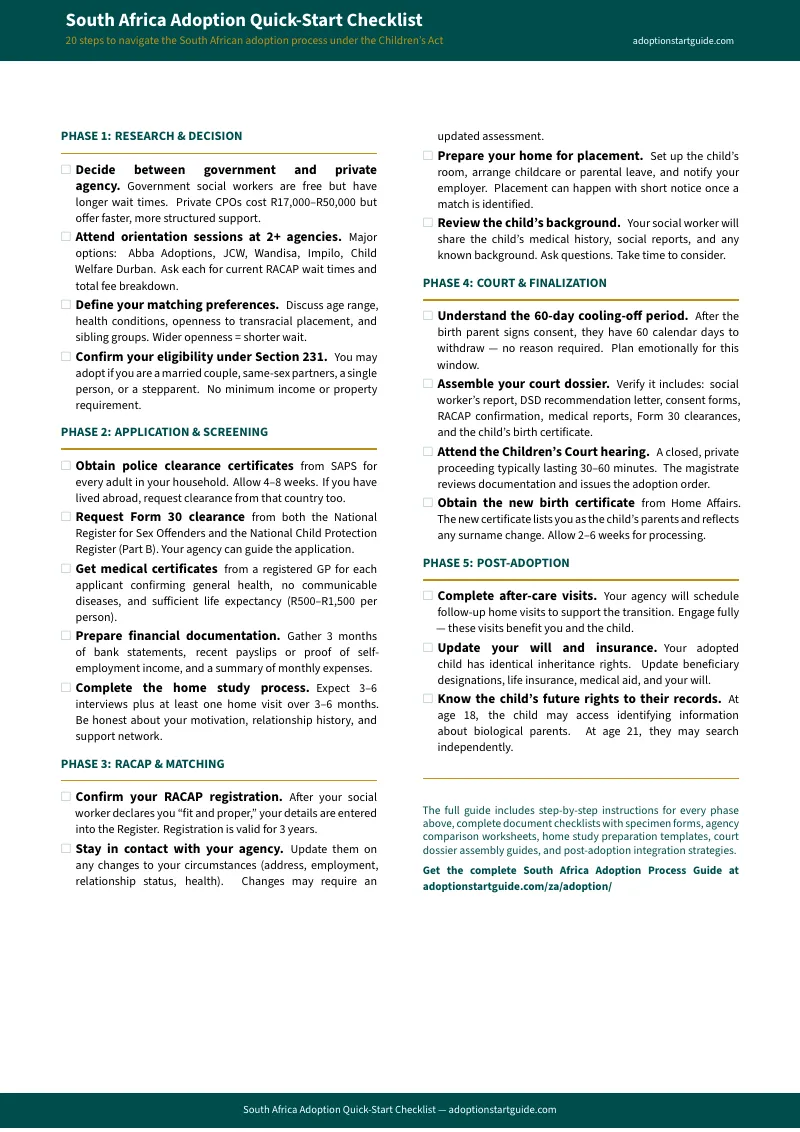
Download the South Africa Adoption Quick-Start Checklist for a one-page overview of the adoption process — the key requirements, the document list, and the first steps to take this week. Free, no commitment. If you want the full guide with the Children's Act breakdown, Section 231 assessment preparation, RACAP wait time analysis, agency comparison, cost breakdown, consent timeline, transracial adoption guidance, court process walkthrough, and complete document checklist, click the button in the sidebar.
— Less Than One Hour of a Social Worker's Regulated Fee
A Regulation 107 counselling session costs R305 per hour. A private agency domestic adoption runs R17,000 to R50,000. A family attorney charges R1,500 to R3,000 per hour. One wrong agency choice can cost you years of waiting in the wrong province. One incomplete Form 30 submission can delay your assessment by months. One misunderstanding of the 60-day consent timeline can cause unnecessary heartbreak. This guide prevents those mistakes.
If the guide does not deliver what you need, reply to your download email at any time for a full refund. No forms. No justification required.