
PEI has one Department, one central office, infrequent PRIDE training cohorts, and a brand-new child welfare law that changed everything about the application process in September 2024.
You called the Department of Social Development and Seniors to ask about becoming a foster parent. They told you to attend an information session. The next one isn't for several weeks. They couldn't tell you what documents to start gathering, how to request your Vulnerable Sector Check, or what the new legislation means for your application. So you hung up and went online.
You found the government website. It told you the basics — minimum age 21, resident for six months, background check, home study. It mentioned 27 hours of PRIDE training but didn't explain what the nine sessions cover or when the next cohort starts. It said a social worker would conduct a "personal" and "evidence-based" home study but didn't give you a checklist for preparing your property. It mentioned monthly compensation but not the lag in reimbursements for clothing and school supplies. And it said you'd need a criminal record check — but not that you need a Vulnerable Sector Check specifically, and that the RCMP won't even process it until you have a letter from the Department.
That last detail alone costs unprepared applicants two trips to the police station and weeks of delay. In a province where PRIDE training runs in small, infrequent cohorts, those lost weeks can mean waiting months for the next available spot.
This is the reality of fostering in Canada's smallest province. The system is centralized — you deal with one Department, not dozens of agencies. That should make things simpler. But the Department's website gives you the bones of the process without the meat. And the 2024 Child, Youth and Family Services Act rewrote the legal framework entirely, which means the advice your neighbour got two years ago is already outdated.
The Island Navigator: One Guide Through PEI's Centralized System
This guide is built for how Prince Edward Island's foster care system actually works in 2026 — the centralized Department structure, the 2024 CYFSA legislation, the PRIDE training curriculum, the SAFE home study methodology, and the specific requirements that apply to Island families with rural properties, newcomer status, or Mi'kmaq community connections. Every chapter reflects current PEI law and procedure, not the pre-2024 information that still dominates search results. It is the operating manual for getting approved as a foster parent on the Island — through the one Department that handles everything, under the rules that took effect nine months ago.
What's inside
- 2024 CYFSA Decoded — PEI repealed the Child Protection Act and replaced it with the Child, Youth and Family Services Act on September 9, 2024. The new law shifts authority from the Director of Child Protection to the Minister of Social Development and Seniors, introduces formal "best interest of the child" tests that consider cultural and linguistic heritage, and extends youth support to age 25. This chapter explains what changed and exactly how it affects your application, your home study, and your responsibilities as a foster parent.
- Vulnerable Sector Check Roadmap — The number-one delay in PEI foster applications. Most applicants go to the police station before they have the Department's letter of documentation, which means the RCMP won't process the request. This chapter gives you the exact sequence: request the letter first, then submit to the correct office — RCMP in Montague has different hours and processing times than Charlottetown Police. One chapter, two trips saved.
- PRIDE Training Preparation — 27 hours across nine sessions of trauma-informed parenting education. The Department's website mentions the training exists. This guide breaks down what each session covers so you aren't blindsided by the content, and explains how the infrequent cohort scheduling works so you can register at the earliest opportunity instead of waiting months for the next available group.
- SAFE Home Study Decoder — The Structured Analysis Family Evaluation is where most applicants feel the most anxiety. The social worker evaluates roughly 70 psychosocial factors across multiple visits. This chapter translates the evidence-based assessment into plain language: what questions to expect, what the assessor actually looks for, and how to prepare your family for the "identity" interview that the 2024 Act now requires — questions about your ability to support a child's specific cultural, ethnic, and linguistic background.
- Rural Property Audit Checklist — PEI is 40% rural. Hobby farms, heritage homes, wood stoves, and working land are normal here. The SAFE assessment isn't a "white picket fence" test — it's a mitigation test. This chapter provides a room-by-room, property-wide checklist for rural families: locking up farm chemicals, securing equipment, fencing hazards, fire safety for wood-heated homes. Pass the home study with the property you have, not the suburban house you don't.
- Newcomer Eligibility Pathway — If you've moved to PEI through the Provincial Nominee Program or Atlantic Immigration Program, you can foster — provided you've been a resident for six months and plan to stay for at least two years. This chapter answers the questions the Department's website doesn't: how your Permanent Residency status interacts with the Foster Parent Agreement, how to handle the Vulnerable Sector Check if you've lived in Canada for less than five years, and what the Department looks for from families with international backgrounds.
- Mi'kmaq and Indigenous Stream Guide — PEI's foster care system operates alongside the Mi'kmaq Confederacy of PEI's Family PRIDE program. This chapter explains the difference between the provincial foster care stream and the MCPEI community-based prevention model, the kinship care and alternative caregiver pathways enhanced under the 2024 CYFSA, and the specific contact details for Lennox Island and Abegweit First Nation band offices.
- Financial Support and Compensation Guide — Monthly foster care allowances, clothing and school supply reimbursements, respite care funding, and the reimbursement lag that catches new foster parents off guard. This chapter provides the actual numbers and explains the payment cycle so you can budget accurately from day one.
Printable standalone worksheets included
- Licensing Timeline Tracker — Every milestone from initial information session through final approval, with fill-in date fields so you always know where your case stands in the Department's process.
- Home Safety Inspection Checklist — Room-by-room and property-wide walkthrough of PEI's home study standards, with a dedicated rural property section for farms, heritage homes, and wood-heated properties.
- Document Preparation Checklist — Vulnerable Sector Check, Child Protection Record Check, medical clearances, references, and training certificates in the order the Department expects them.
- Monthly Budget Worksheet — Foster care allowance rates, reimbursement categories, and household expense tracking in one printable sheet.
Who this guide is for
- Legacy Islanders ready to give back — You've lived on the Island for years. You've seen the CBC reports about siblings being separated because no home can take all three. You know someone in the system — a foster parent aging out, a social worker at your rink. You want to help, but the Department's process feels opaque from the outside. This guide translates the bureaucracy of the Jones Building into a step-by-step plan so your community impulse becomes an approved foster home.
- Newcomers building Island roots — You came through the PNP or Atlantic Immigration Program and you want to contribute to your new community. You qualify to foster, but nobody's told you that yet — and the Department's website doesn't address how your immigration status interacts with the application. This guide does.
- Rural and farm families — You have the space, the stability, and the heart for fostering, but you're worried your farmhouse, your woodstove, or your working land won't pass a home study. The rural property checklist shows you exactly what needs mitigation and what's already fine.
- Empty nesters and second-chapter families — Your children are grown and you have bedrooms, patience, and life experience. You want to know whether fostering is realistic at this stage and what the process actually requires. This guide answers both questions without the vague encouragement you've found elsewhere.
- Mi'kmaq community members — You're exploring whether the provincial foster care system or the MCPEI Family PRIDE program is the right fit for your family and community. This guide maps both pathways and the kinship care options under the 2024 CYFSA.
- Information session attendees — You went to the Department's information session in Charlottetown, Summerside, or Montague. It gave you an overview. You left with more questions than answers. This guide picks up where the session stopped.
Why the free resources fall short
The Government of Prince Edward Island website lists the eligibility criteria and mentions the main steps — information session, PRIDE training, home study, approval. It tells you what the rules are. It does not tell you how to follow them without failing the SAFE interview, how to avoid the Vulnerable Sector Check delay that costs most applicants weeks, or how the 2024 CYFSA changed the legal tests your home study will be evaluated against. The website is a directory. It is not a roadmap.
Etsy sells foster care binders for $15 to $35 — medication logs, visit trackers, daily schedules. These are tools for after you're approved and a child is in your home. They do nothing to get you through the application phase. They don't explain PRIDE training content, SAFE home study preparation, or the records check sequence. They organize the life of fostering without addressing the process of becoming a foster parent.
Generic Canadian foster care guides cover the national landscape. They don't know that PEI's system is run by a single Department, that the CYFSA replaced the Child Protection Act nine months ago, that PRIDE cohorts run infrequently and fill quickly, or that the RCMP office in Montague has different hours than Charlottetown Police. In a province this small, generic advice isn't just unhelpful — it's misleading.
The free Quick-Start Checklist
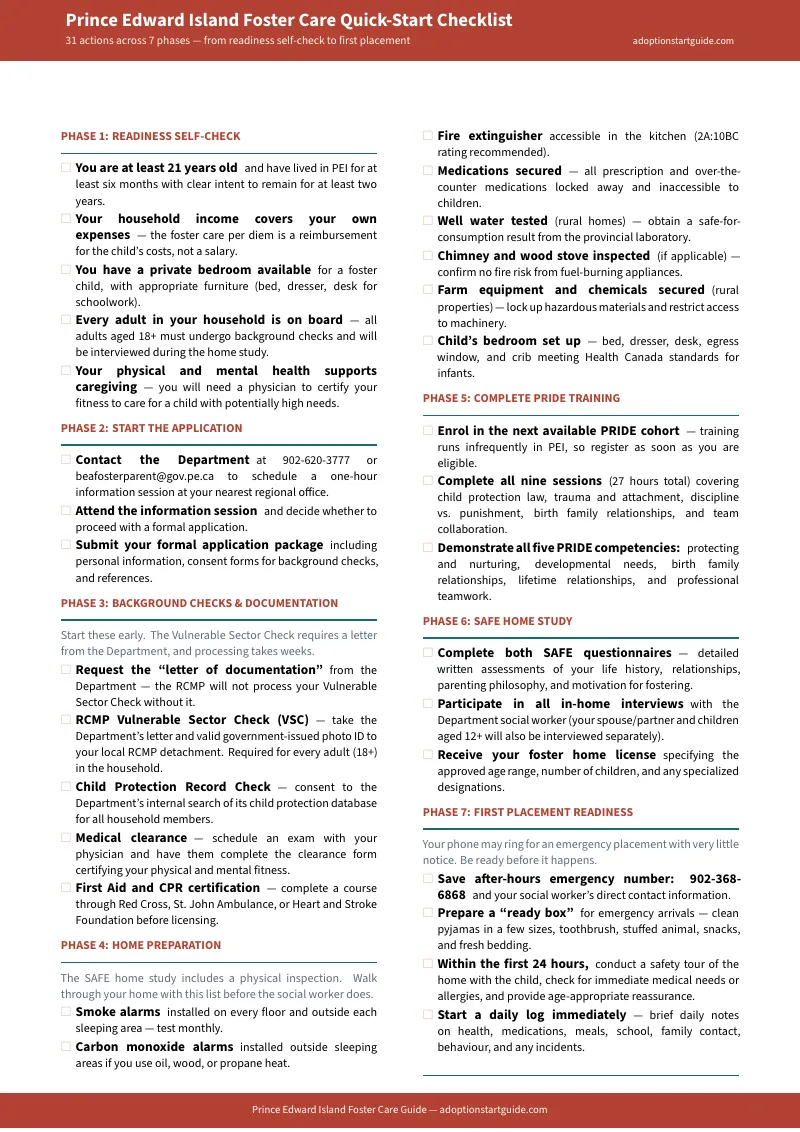
If you're not ready for the full guide, start here. Download the Prince Edward Island Foster Care Quick-Start Checklist for a one-page action plan covering the licensing process in the order the Department expects you to complete it. Free, no commitment. It includes the key contact numbers for the Department's regional offices and a reminder about the Vulnerable Sector Check sequence so you don't lose weeks to the most common delay. If you want the full guide with the CYFSA decoder, PRIDE training preparation, SAFE home study walkthrough, rural property audit, newcomer pathway, and all four printable worksheets, click the button in the sidebar.
— less than one dinner at a Charlottetown restaurant
A missed PRIDE cohort costs you months of waiting for the next one. A failed first home study visit because you didn't understand the 2024 "best interest" identity questions means a follow-up visit and more delay. Two trips to the police station because nobody told you about the Department's letter requirement wastes a week you didn't have. This guide puts the entire PEI foster care system — the 2024 CYFSA framework, the Vulnerable Sector Check sequence, PRIDE training preparation, SAFE home study decoder, rural property audit, newcomer eligibility pathway, Mi'kmaq community options, financial planning, and four printable worksheets — in your hands for less than what you'd spend on a single meal out.
If the guide doesn't deliver, reply to your download email at any time for a full refund. No forms. No justification required.