You called the DCS hotline, visited dcs.az.gov, and left with a list of forms — CSO-3205, CSO-1035A, DCS-1078 — and no explanation of which one to file first.
Arizona runs foster care through the Department of Child Safety, the Office of Licensing and Regulation, private licensing agencies, and the Department of Public Safety — four separate bureaucracies that each assume you already understand the other three. DCS posts orientation steps. OLR conducts the Life Safety Inspection. Your agency handles the home study. And DPS controls the Level 1 Fingerprint Clearance Card that gates the entire process. Nobody maps how these pieces connect, what order they happen in, or what goes wrong when you sequence them incorrectly.
The fingerprint card alone derails more Arizona applications than any other single requirement. You need to navigate the DPS Public Service Portal, understand the difference between IVP (Identity Verified Prints) and Non-IVP submissions, get the A-prefixed reference number before you can even schedule an appointment at a Fieldprint Livescan location, and pay $22 to $67 per adult household member. Submit the wrong print type and you're looking at a 90-day delay while the system reprocesses. Have a decade-old misdemeanor nobody told you about? The card gets denied, and you don't know the Good Cause Exception exists — a formal appeal to the Board of Fingerprinting that can reverse the denial if you demonstrate rehabilitation. Families quit at this step because they think a denial is final. It's often not.
Meanwhile, your home has its own obstacle course. Arizona's Life Safety Inspection under A.A.C. Title 21 Chapter 8 is one of the strictest in the country. Pool fences must be five feet high with self-closing, self-latching gates that open away from the pool under R21-8-113 — a $2,500 retrofit in the Phoenix metro if your existing fence is four feet six inches. Firearms must be unloaded, trigger-locked, and stored in an unbreakable locked container with ammunition in a separate locked area under R21-8-106. Every medication — prescription and over-the-counter — goes in a locked cabinet, and refrigerated medications need a locked box inside the refrigerator. One failed inspection delays your licensing by months.
The Arizona Licensing Roadmap
This guide is built exclusively for Arizona's DCS system and nobody else's. Every chapter, every checklist, every form reference is grounded in current Arizona Revised Statutes Title 8, the Arizona Administrative Code Title 21, DCS policy, and the real-world experience of families who have navigated licensing in Maricopa, Pima, Coconino, Yuma, and the tribal regions. Not a national foster care overview. Not an agency recruitment brochure. The operational layer between what the state posts online and what you actually need to know to get licensed — under current conditions, on current timelines.
What's inside
- Level 1 Fingerprint Clearance Card walkthrough — This is where most Arizona applications stall, and nobody warns you in advance. This chapter walks you through the DPS Public Service Portal step by step: creating your account, selecting the correct clearance type (IVP vs. Non-IVP), obtaining the A-prefixed reference number that unlocks appointment scheduling, finding a Fieldprint Livescan location, and understanding the 90-day processing window. Covers every adult household member's requirements, the $22 to $67 fee structure, and the complete Good Cause Exception process through the Board of Fingerprinting for families with past offenses that are eligible for appeal. The single most valuable chapter in the guide — it prevents the delay that causes more families to abandon the process than any other factor in Arizona.
- Agency comparison matrix — DCS legally cannot recommend one private licensing agency over another. That leaves you guessing between Arizona's Children Association, Child Crisis Arizona, Catholic Charities, A New Leaf, StepStone, and Christian Family Care based on nothing more than a website and an intake call. This chapter compares the major agencies by geographic coverage, specialization (therapeutic foster care, medically complex, LGBTQ+, military, faith-based), responsiveness, training format, and the populations they serve best. Includes regional recommendations for Maricopa County, Pima County, Northern Arizona, and rural areas so you choose the agency that matches your family's situation — not just the one with the best marketing.
- Life Safety Inspection room-by-room prep guide — The OLR inspector checks your home against A.A.C. Title 21 Chapter 8 standards, and the pass/fail line is far more specific than "clean and safe." This chapter gives you the complete room-by-room walkthrough: pool fence height and gate specifications under R21-8-113, firearm storage requirements under R21-8-106, medication lockbox standards, water heater temperature (120 degrees Fahrenheit maximum), smoke detector placement, 2A:10BC fire extinguisher location, cleaning supply storage, window screen requirements, and the written emergency evacuation plan that must be posted in a common area. Handle every item before the inspector arrives, not after the correction plan adds weeks to your timeline.
- Board rates and financial self-sufficiency calculator — Arizona's daily room and board rates jumped 50% for children aged 6-18 in December 2025, bringing rates to $19.68 per day (ages 0-5), $32.88 per day (ages 6-11), and $45.95 per day (ages 12-18). But you receive nothing until you are fully licensed — every week of delay is a week without reimbursement. This chapter covers the current rate tiers, the clothing allowance, the personal allowance, Mercy Care DCS Comprehensive Health Plan coverage, and the financial self-sufficiency calculation on Screen 11 of the licensing portal. That calculation — your income minus your expenses must be greater than or equal to zero without counting the foster care stipend — is where families get tripped up. This chapter shows you how to pre-calculate it so you don't trigger an immediate denial at the application stage.
- Pre-service training navigator — Arizona uses a blended training model through the TraCorp Learning Management System: three online prerequisites followed by ten live webinars over five weeks, with the entire track to be completed within eight weeks. This chapter breaks down the prerequisite modules (DCS overview, trauma basics, Reasonable and Prudent Parent Standard), the live webinar sequence (shared parenting, trauma impact, behavioral support, cultural identity, ICWA, permanency), the CPR/First Aid certification, and the mandated reporter training under ARS Section 13-3620. Includes the technical setup requirements — unique email per participant, camera, microphone — and what happens if you miss a session and need to join the next cohort.
- ICWA compliance guide for Arizona's 22 tribal nations — Arizona has the third-largest Native American population in the United States. If a child placed in your home is a member of or eligible for membership in a federally recognized tribe — Navajo, Tohono O'odham, Gila River, Salt River Pima-Maricopa, Hopi, and 17 others — the Indian Child Welfare Act establishes placement preferences that override standard DCS procedures. This chapter explains what "active efforts" means in practice, the placement preference hierarchy (relative, tribal member, other Indian family, then non-Indian family), how to contact tribal social services, and how to support a child's cultural and tribal connections. Written to replace the fear with understanding so ICWA doesn't become a reason to quit the process.
- Kinship fast-track pathway — 47.9% of Arizona's foster placements go to kinship caregivers — grandparents, aunts, uncles, family friends — a rate far above the national average of 32%. If you're suddenly caring for a relative's child, the timeline compresses dramatically. You may have a child in your home before you've begun any paperwork. This chapter walks you through the emergency placement protocol, the expedited background check process, accessing financial support (SB 1602 and SB 1490 kinship stipends), and the path from unlicensed kinship placement to full licensure so your placement is stable, supported, and funded.
- Form number walkthroughs — CSO-3205 (licensing checklist), CSO-1035A (foster home application), DCS-1078 (placement agreement), CSO-1227A (life safety inspection report), CSO-1601 (preparation guide) — Arizona's form numbers read like a parts catalog. This chapter maps every required form to its licensing phase, explains what information each form asks for, identifies the fields where errors cause rejections, and provides a submission sequence so your file arrives at OLR complete on the first attempt. Includes the physician's health statement, the five reference letters (maximum two from relatives), and the floor plan requirement.
Printable standalone worksheets included
- Licensing Timeline Tracker — Every milestone from first agency contact through OLR certification, with fill-in date fields. Print it, update it after every caseworker interaction, and always know where you stand in the four-to-six-month process.
- Home Safety Inspection Checklist — Room-by-room walkthrough of every A.A.C. Title 21 Chapter 8 requirement. Walk your home with this before the OLR inspector arrives.
- Document Organization Sheet — CSO-3205, CSO-1035A, Level 1 Fingerprint Cards, physician's statements, training certificates, reference letters — every document organized by phase with checkboxes and submission dates.
- Financial Planning Worksheet — Current board rates by age group, clothing and personal allowances, Mercy Care coverage, and your financial self-sufficiency pre-calculation in one printable sheet.
Who this guide is for
- Phoenix metro families navigating agency selection — You live in Maricopa County. You've found six agencies and attended two orientations that felt more like recruitment pitches than preparation sessions. DCS can't recommend one agency over another, so you're left comparing websites and hoping for the best. This guide gives you the agency comparison matrix that the system is designed not to provide.
- Faith-based families answering the call — You're connected through Arizona Faith and Families, Christian Family Care, Catholic Charities, or your congregation's foster care ministry. The calling is clear. The DPS fingerprint portal, the A.A.C. Title 21 inspection standards, and the TraCorp training system are not. This guide maps the licensing process so the bureaucracy doesn't derail your mission.
- Kinship caregivers who need answers now — A grandchild, niece, nephew, or family friend's child has been placed with you or is about to be. You need to understand the expedited pathway, access financial support you're entitled to, and get licensed so your placement is stable. 47.9% of Arizona placements are kinship — this guide has a dedicated chapter for your situation.
- Families with pools, firearms, or older homes — Your pool fence is four feet eight inches instead of five feet. Your gun safe doesn't meet the "unbreakable locked container" standard. Your water heater is set to 140 degrees. A failed Life Safety Inspection delays your licensing by months. This guide gives you every measurement, every standard, and every fix before the OLR inspector arrives.
- Foster-to-adopt families — You're entering the foster care system hoping to provide a permanent home. Arizona prioritizes reunification, and concurrent planning requires preparation that orientations don't cover. This guide explains how the transition from foster license to adoption works, the legal timeline for termination of parental rights, and what "concurrent" means in daily life when you're attached to a child whose plan is still return home.
- Families in Pima County, Flagstaff, Yuma, and rural Arizona — The DCS website is Phoenix-centric. Your licensing agency options are fewer, your DCS field office may schedule orientations quarterly, and you feel disconnected from the centralized process. This guide covers the Arizona Administrative Code, which applies statewide — whether you're in Tucson, the Navajo Nation border towns, or Sierra Vista.
- Single adults and LGBTQ+ families — Arizona law allows single adults 21 and older and LGBTQ+ individuals and couples to foster. The administrative code welcomes diverse families regardless of sexual orientation or gender identity. This guide addresses the specific concerns you face — proving financial stability solo, navigating agency selection in a state where some faith-based agencies have particular orientations, and demonstrating your support network to the home study evaluator.
Why the free resources aren't enough
The DCS website is a form repository, not a guide. It publishes the CSO-3205 licensing checklist, the CSO-1601 Life Safety Inspection preparation booklet, and the training FAQs. It does not tell you the order in which to complete these steps, what happens when your fingerprint card is delayed by 90 days because you submitted Non-IVP prints instead of IVP, or how to choose between six private agencies when DCS is legally prohibited from recommending one.
Agency orientation sessions are recruitment events. They exist to inspire you to apply, not to prepare you to succeed. You'll hear about Arizona's 9,221 children in care and the 853 new homes DCS needs to recruit. You won't get a strategy for passing the Life Safety Inspection or a walkthrough of the DPS fingerprint portal that determines whether your application moves forward or stalls for three months.
Facebook groups — Arizona Foster Parents, the Phoenix and Tucson subreddits — provide emotional support and conflicting advice. A family whose agency handled everything in Maricopa County gives different guidance than a kinship caregiver in Yuma who's navigating emergency placement without a caseworker who returns calls. An answer that worked for one agency may be wrong for yours. Crowdsourced guidance is well-intentioned and situationally contradictory.
National foster care books describe a generic licensing process that doesn't account for Arizona's Level 1 Fingerprint Clearance Card system, the IVP vs. Non-IVP distinction, the A.A.C. Title 21 pool fence and firearm storage requirements, the TraCorp blended training model, or the fact that 47.9% of placements go to kinship caregivers who need a completely different pathway. A guide written for Ohio or Pennsylvania won't help you in Arizona.
The free Quick-Start Checklist
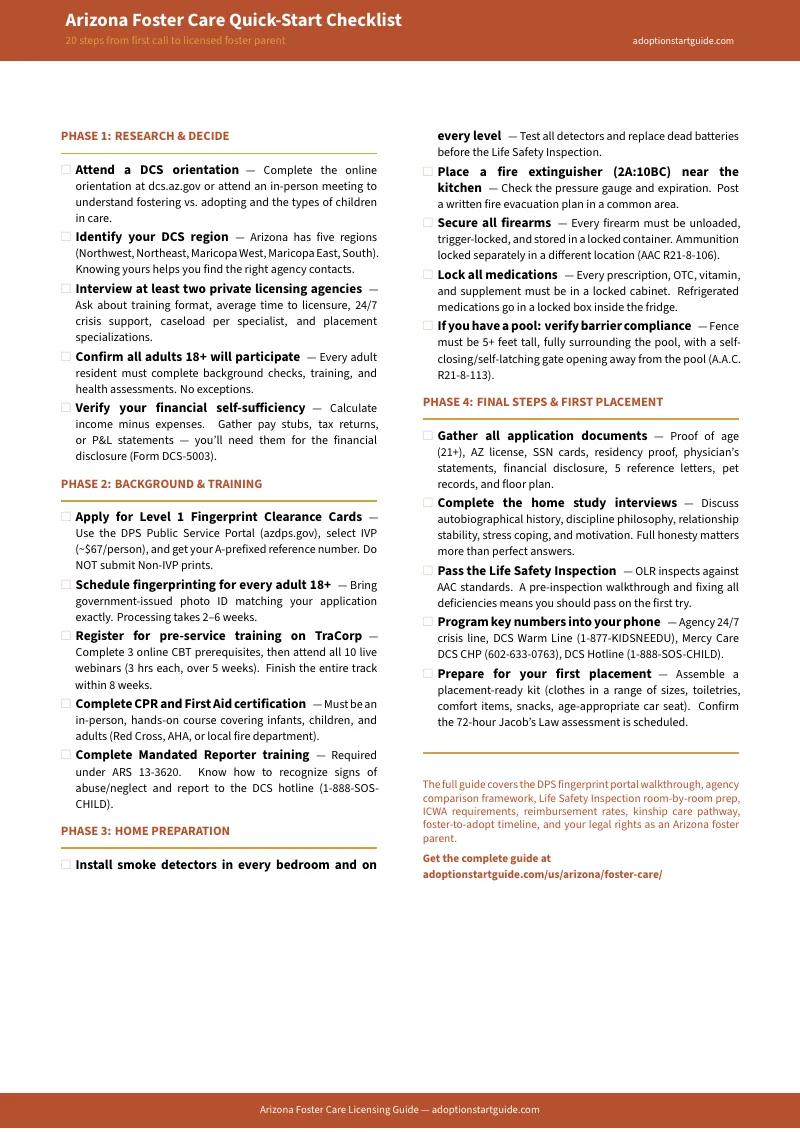
Download the Arizona Foster Care Quick-Start Checklist for a one-page overview of the licensing process, from first agency contact through OLR certification. Free, no commitment. If you want the full guide with the fingerprint card walkthrough, agency comparison matrix, room-by-room LSI prep, financial self-sufficiency calculator, ICWA compliance guide, kinship fast-track pathway, and all the printable worksheets, click the button in the sidebar.
— less than one fingerprint clearance card application
The Level 1 Fingerprint Clearance Card costs $22 to $67 per adult. A medical physical for your household runs around $600 if you're uninsured. A pool fence retrofit in Phoenix averages $2,500. And every week your licensing is delayed by a paperwork error or a failed inspection is a week you're not receiving the $590 to $1,400 monthly board rate. This guide costs less than the cheapest background check you're already going to pay for — and it prevents the mistakes that turn a four-month process into an eight-month ordeal.
If the guide doesn't deliver, reply to your download email at any time for a full refund. No forms. No justification required.