
DC has 15+ private foster care agencies, and CFSA won't tell you which one is right for your family. The wrong choice costs you months.
You decided to foster in the District. You went to the CFSA website expecting a government application form. What you found instead was a system that doesn't work like any other jurisdiction in the country. The Child and Family Services Agency manages DC's child welfare system, but it doesn't directly license most foster homes. That job belongs to more than fifteen private contracted agencies — organizations like Paths for Families, NCCF, Progressive Life Center, Community Connections, and Mary's Center — each with different specialties, response times, training schedules, and organizational cultures.
CFSA's website lists these agencies. It does not compare them. It does not tell you which agency handles the most infant placements, which one has been vetted by the Human Rights Campaign for LGBTQ+ inclusion, which one specializes in therapeutic foster care for teens with trauma histories, or which one will actually return your orientation inquiry call within a week. The result is a selection paradox that freezes motivated families: you're ready to foster, but you're terrified of picking the wrong agency and wasting three to six months in the wrong pipeline before you realize the fit is wrong.
Meanwhile, you found the DCMR Title 29 regulations and tried to figure out whether your apartment in Adams Morgan or your rowhouse in Capitol Hill meets the physical environment standards. The regulations are written in legal language for compliance officers, not for a professional in Ward 1 trying to determine whether a 10-by-7 den counts as a qualifying bedroom for a foster child. You learned about the Clean Hands Certification requirement and wondered whether that unpaid parking ticket from 2023 would derail your entire application. You heard about the Professional Foster Parent track that pays a $70,000 salary and couldn't find anyone who would explain the actual eligibility criteria.
The information exists. It's scattered across CFSA policy manuals, individual agency recruitment pages designed to funnel you into their specific program, Reddit threads with outdated advice from before the LaShawn A. consent decree ended, and Facebook groups where anecdotes substitute for regulatory knowledge. You can spend three months assembling this picture yourself. Or you can read the guide.
The System Translator: Your DC Foster Care Licensing Guide
This guide is built for DC's public-private agency system and nobody else's. Every chapter, every checklist, every recommendation is grounded in the DCMR Title 29 regulations, CFSA's current operational framework, the 2025 board rate schedule, and the practical realities of navigating fifteen-plus contracted agencies in a 68-square-mile urban jurisdiction. It covers the gap between what CFSA publishes online and what you actually need to know to get from "interested" to "licensed" without the agency-shopping paralysis, the failed inspections, or the months of silence from an overwhelmed licensing worker.
What's inside
- Agency Selection Framework — DC's 15+ private agencies differ dramatically in specialty, culture, and responsiveness. This chapter provides a structured comparison rubric covering placement specialties (infants, teens, therapeutic, traditional), LGBTQ+ inclusion credentials, geographic coverage, training schedules, and response time expectations. Stop guessing which agency to call. Compare them on the criteria that actually matter for your family, and attend orientation already knowing what to look for.
- DCMR Title 29 Urban Housing Decoded — The 70-square-foot single bedroom minimum, 100-square-foot shared room standard, egress requirements, window guard mandates, hot water temperature limits, and every other physical environment regulation translated from legal language into plain English with specific guidance for apartments, condos, and rowhouses. If you've been hesitating because you assumed your urban home wouldn't qualify, read this chapter before you self-disqualify.
- CFSA System Architecture — How the public-private partnership works, why you apply through an agency instead of the government, what CFSA's role is versus your agency licensing worker's role, how the "Four Pillars" framework shapes placement decisions, and why understanding the system architecture prevents the confusion that stalls most applicants in their first month.
- Background Check and Clearance Strategy — FBI fingerprint timeline, DC Metropolitan Police clearance, Child Protection Register search, Sex Offender Registry check, health examinations and TB screening requirements for every adult household member, and the Clean Hands Certification from the Office of Tax and Revenue — the requirement that catches more DC applicants off guard than any other. If you owe more than $100 in DC fines, taxes, or penalties, this chapter tells you exactly how to resolve it before it becomes a bottleneck.
- TIPS-MAPP Training Walkthrough — The mandatory pre-service training broken down session by session: what each module covers, what your trainer is evaluating, how long the full commitment takes, and how to find cohort schedules through your agency that fit your work life in a city where the professional class doesn't have standard nine-to-five schedules.
- Home Study Preparation — What the licensing worker actually evaluates during interviews, the questions they ask about discipline philosophy and personal history, what causes real denials in DC versus the urban myths that circulate in Facebook groups, and how to prepare honestly without over-rehearsing into a performance that raises its own red flags.
- Financial Reality in a High-Cost City — DC's daily board rates broken down by age and level of care — among the highest in the region, designed to offset the District's cost of living. Side-by-side comparison with Maryland and Virginia rates showing the DC advantage. The Professional Foster Parent salaried track explained. Clothing allowances, supplemental support, and an honest breakdown of what the stipend covers versus what you'll spend out of pocket in a city where groceries and childcare cost more than the national average.
- LGBTQ+ Family Vetting — DC has strong legal protections, but agency-level culture varies. This chapter identifies which agencies carry the Human Rights Campaign's All Children-All Families designation, what that credential actually means in practice versus legal compliance, and how to assess genuine cultural competency during your orientation visit — because "we don't discriminate" and "we celebrate your family" are not the same sentence.
- Kinship Care Path — If a grandchild, niece, nephew, or family friend's child was placed with you by CFSA, you're already parenting. This chapter covers the kinship licensing pathway, emergency placement procedures, the financial gap between licensed and unlicensed kinship care, which requirements can be adjusted for relative placements, and how to transition from crisis mode to stable, supported caregiving.
- Foster-to-Adopt Pathway — How concurrent planning works in DC, when reunification gives way to permanency, how the Adoption and Guardianship Subsidy operates, and the realistic timelines for foster-to-adopt cases in the District's current system.
Printable tools and worksheets included
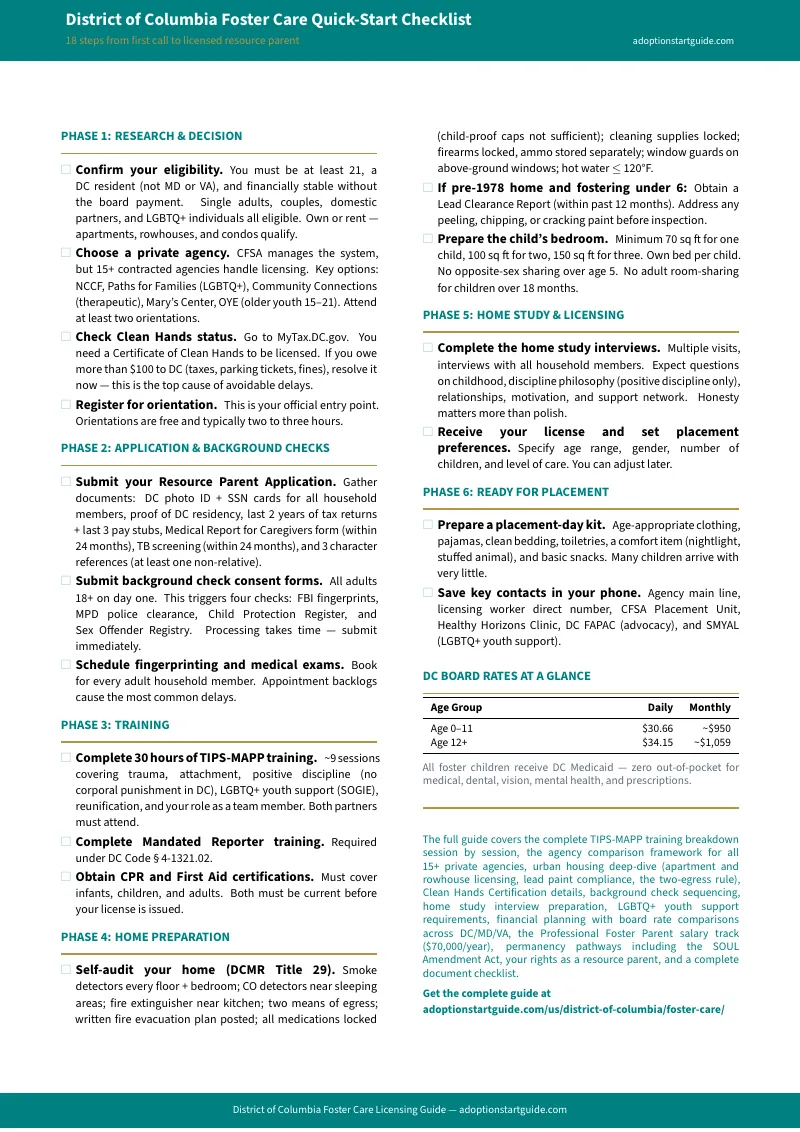
- 18-Item Quick-Start Checklist — Every critical action from confirming eligibility through post-licensing obligations, organized into five phases. Print it, check items off as you complete them, and always know exactly where you stand in the process.
- Agency Comparison Worksheet — Landscape fillable table for comparing three agencies side by side across specialties, LGBTQ+ credentials, caseloads, crisis support, and responsiveness. Bring it to orientation visits.
- Agency Orientation Questions — The five questions to ask at every agency orientation, with space to write answers and compare agencies before committing.
- Application Document Tracker — Every required document with date-obtained columns and processing time estimates so nothing falls through the cracks.
- Document Gathering Checklist — Timeline-annotated checklist showing how long each clearance takes, organized by application phase so you start the slowest items first.
- Home Safety Inspection Checklist — Room-by-room walkthrough matching exactly what the licensing worker evaluates, with DC-specific requirements for window guards, locked medication storage, and lead clearance.
- Board Rates Reference Card — Landscape fridge sheet with DC's daily rates by age and care level, side-by-side MD/VA comparison, Medicaid coverage, clothing allowances, and the Professional Foster Parent track.
- First Placement Quick Reference — What to discuss on the placement call, what to do when the child arrives, first 24-hour priorities, and first-week action items with fillable key contacts.
Who this guide is for
- First-time prospective foster parents — You've been researching for weeks. You've visited the CFSA website, browsed the FosterDCKids.org agency list, read three Reddit threads with conflicting advice, and you still don't know which agency to call first. You need someone to lay out the process in the order you'll actually encounter it, in language that assumes you're smart but doesn't assume you understand DC's regulatory infrastructure.
- Apartment and condo residents — You live in Ward 1, 3, or 6. Your place is comfortable for you, but you've convinced yourself it's too small to foster. You need the actual DCMR Title 29 square footage standards and an honest assessment of what caseworkers evaluate during urban home inspections — not generic advice written for suburban houses with spare bedrooms and backyards.
- LGBTQ+ families — DC is one of the most welcoming jurisdictions in the country for queer foster and adoptive parents. But "DC is welcoming" and "every agency in DC is welcoming" are different statements. You want to know which agencies have been externally vetted for inclusive practices — not just legally compliant, but genuinely affirming.
- Kinship caregivers — A child in your family was removed and placed with you. You didn't plan for this. The child is already here. Now you need to understand the licensing process, the financial support available to you, and why getting formally licensed as a kinship provider changes the math on everything from board payments to caseworker support.
- Policy and advocacy professionals — You work in the child welfare ecosystem. You know the system intellectually. You've never navigated it personally. This guide bridges the gap between understanding CFSA's strategic framework and actually completing a foster care application through a private agency.
Why the free resources fall short
CFSA publishes the DCMR Title 29 regulations, a resource parent handbook, and a list of contracted agencies on its website. These materials are comprehensive and accurate. They are also designed for compliance documentation and system-level communication, not for a first-time applicant sitting at a laptop trying to figure out which of fifteen agencies to call. The agency list tells you who exists. It doesn't tell you who specializes in what, who responds quickly, or who has earned external credentials for LGBTQ+ inclusion.
Individual agency websites — Paths for Families, NCCF, Progressive Life Center, Community Connections — are recruitment tools designed to funnel you into their specific program. They describe what they offer. They don't explain the landscape of competing options or help you understand what makes one agency a better fit for your family than another.
Reddit and Facebook groups provide raw authenticity from real DC foster parents, but anecdotes from 2019 don't reflect the post-LaShawn system. Board rate numbers from three years ago don't match today's schedule. And the advice to "just call CFSA" leads you to a phone tree that redirects you to the agency list you started with.
National foster care books describe a state-run model that doesn't exist in DC. If a guide tells you to "contact your state child welfare office and submit an application," it was not written for a jurisdiction where the government office doesn't license most foster homes directly.
The free Quick-Start Checklist
Download the DC Foster Care Quick-Start Checklist for a five-phase overview of the licensing process: research and agency selection, application and background checks, training, home study, and post-licensing obligations. Free, no commitment. If you want the full guide with the Agency Selection Framework, DCMR housing standards, Clean Hands walkthrough, financial breakdown, LGBTQ+ vetting, kinship path, and the complete home study preparation, click the button in the sidebar.
— less than one Uber ride across the District
The typical DC applicant spends one to three months piecing together the licensing process from CFSA publications, agency websites, and social media threads before they feel confident enough to pick up the phone. A poor agency choice — one that's unresponsive, culturally wrong, or specialized in a placement type you didn't want — can cost you six months and a restart. An avoidable Clean Hands issue can freeze your application for weeks. A bedroom measurement you could have checked in five minutes can turn a passed home inspection into a failed one.
If the guide doesn't deliver, reply to your download email at any time for a full refund. No forms. No justification required.