
New Jersey has 21 county surrogates, three competing adoption pathways, a 72-hour birth parent surrender window, and a legal vocabulary that trips up even experienced family attorneys from other states.
You searched "how to adopt in NJ" and found the DCF Adoptive Parent Handbook. It walked you through the foster-to-adopt path through CP&P. It did not mention that private agency infant adoption costs $25,000 to $50,000 and follows an entirely different legal track. It did not explain the difference between a "surrender" and "consent" — a distinction that can invalidate an adoption if your paperwork uses the wrong word. And it did not tell you that your County Surrogate's Office in Bergen County has different local forms and copy requirements than the one in Monmouth County.
So you went to NJ ARCH. You found podcasts, webinars, a lending library, and a Spanish-language resource section. You did not find a Step 1-Step 2-Step 3 action plan. You went to Reddit and Facebook groups. You found conflicting advice from parents who adopted five years ago under a different statutory framework. You called an attorney. The initial consultation was $400, and most of it was spent explaining the basics you should have already known.
That $400 hour is the real cost of starting without a roadmap. Not because the attorney was unhelpful — but because you paid a $400-per-hour professional to deliver a $0-per-hour orientation.
The Pathway Navigator: One Guide Across All Six NJ Adoption Routes
This guide maps every adoption pathway available under New Jersey law — public foster-to-adopt through CP&P, private licensed agency, independent domestic, stepparent, kinship, and adult adoption — side by side, with the real costs, real timelines, and real legal requirements for each one. It cites the actual N.J.S.A. Title 9 statutes your attorney will reference, explains the county surrogate system across all 21 counties, and addresses the financial realities of adopting in one of the highest-cost states in the country. It is the operating manual that the DCF handbook, NJ ARCH, and your county surrogate's office each give you a piece of — assembled into one sequenced document.
What's inside
- Six-Pathway Comparison — The only side-by-side breakdown of public CP&P foster-to-adopt ($0 to $2,700), private agency ($25,000 to $50,000), independent ($15,000 to $53,000), stepparent ($1,500 to $5,000), kinship, and adult adoption. Costs, timelines, legal requirements, and risk profiles for each route so you choose the pathway that fits your family's budget, timeline, and tolerance for uncertainty.
- N.J.S.A. Title 9 Decoder — Plain-language translations of the statutes that govern every adoption in New Jersey. Section 9:3-41 on the 72-hour surrender rule. Section 9:3-39.1 on the criminal penalties for unlicensed intermediaries. Section 9:3-43 on age requirements. Section 9:3-48 on stepparent investigation waivers. The statutes your attorney bills $400 per hour to explain, decoded in the language you actually think in.
- The Surrender Safe Points — The number-one fear in New Jersey adoption is a birth parent changing their mind. This chapter maps the exact legal moments when an adoption moves from revocable to irrevocable: the 72-hour post-birth waiting period, the difference between agency surrender (irrevocable upon execution) and private placement surrender (revocable until the Preliminary Hearing), and the 120-day birth father rule. You will know the precise moment your adoption is legally secure under NJ law.
- SAFE Home Study Walkthrough — Every NJ adoption requires a Structured Analysis Family Evaluation conducted by a licensed agency. This chapter covers what the assessor evaluates across multiple visits — joint and individual interviews, financial review, home safety inspection, and the three personal references. It explains what questions to expect and how to prepare your home and family so you pass on the first attempt.
- County Surrogate Filing Guide — All 21 NJ counties have a Surrogate's Office that handles adoption filings. While the law is statewide, each office has its own local forms, copy requirements, and scheduling quirks. This chapter covers the filing process, required documents (Verified Complaint, Order Fixing Date, Draft Judgment, DOH-1928 form, background clearances), the $175 filing fee, and the finalization hearing — including the requirement that children age 10 and older must attend and may express their preference.
- Financial Stacking Strategy — How to combine the 2025 Federal Adoption Tax Credit (up to $17,280 per child) with NJ employer adoption benefits ($5,000 to $15,000 from major Garden State employers in pharma, tech, and finance), CP&P adoption subsidies for special-needs placements, and grants from organizations like the National Adoption Foundation. A family that stacks all available benefits can offset $30,000 or more against a private adoption — but only if they know what to apply for and when.
- 2017 Adoptees Birthright Act — New Jersey is one of the few states that gives adult adoptees unrestricted access to their original birth certificates. This chapter explains what the law provides, the birth parent redaction window, Contact Preference Forms, and what this means for adoptive families having honest conversations with their children about identity and origins.
- ICWA and Tribal Considerations — If the child has any potential Native American heritage, the Indian Child Welfare Act overrides NJ's standard 72-hour surrender rule with a 10-day waiting period. This chapter covers the federal ICWA requirements, explains New Jersey's unique position with state-recognized tribes like the Ramapough Lenape, and details why NJ judges still use ICWA checklists even when federal recognition is unclear.
- Interstate Compact (ICPC) — If you are adopting a child born in another state, or if a birth parent is out-of-state, the Interstate Compact on the Placement of Children governs the transfer. This chapter covers the ICPC Form 100A process, the NJ ICPC office in Trenton, and the critical rule: do not leave the birth state with the child until you have written clearance.
- LGBTQ+, Single Parent, and Transracial Adoption — New Jersey is one of the most legally inclusive states for adoption. Same-sex couples have identical adoption rights. Single parents face no statutory barriers. This chapter covers agency selection strategies for diverse families and the practical considerations for transracial placements, including cultural competency resources.
Who this guide is for
- Couples exploring adoption after infertility treatment — You have spent years navigating NJ's world-class reproductive medicine centers. You approach adoption with the same analytical mindset you brought to IVF. You want a guide that matches the precision of the medical reports you have been reading, not a motivational pamphlet. This guide delivers the procedural and financial specifics that let you evaluate adoption as the next step, not a consolation prize.
- Resource families transitioning from foster care to adoption — You are already a CP&P-approved resource parent. The child in your home has had their case goal changed from reunification to adoption. The DCF handbook told you how to become a foster parent. It did not prepare you for the termination of parental rights process, the adoption subsidy negotiation, or the county surrogate filing requirements. This guide covers the legal phase the handbook skips.
- Stepparents and kinship caregivers — You have been acting as this child's parent. You want to make it official. You need to know whether the other biological parent must consent, how to handle an absent birth father, what the Surrogate's Office requires for your filing, and how much it will cost. This guide answers those questions with the NJ-specific legal details, not the generic advice you found on legal template sites.
- LGBTQ+ families and single parents — New Jersey's legal framework is protective of your rights. But not every agency is equally experienced with same-sex or single-parent placements, and the home study process has nuances for non-traditional family structures. This guide identifies which agencies have the strongest track records and explains the specific protections NJ law provides.
- Anyone who just spent $400 on a basic attorney orientation — You now realize that half of that billable hour covered information you could have learned in advance. This guide is the preparation you do before the first meeting so that every minute of attorney time goes toward your specific case, not toward explaining how the NJ system works.
Why the free resources fall short
The DCF Adoptive Parent Handbook covers the foster-to-adopt pathway through CP&P. It does not address private agency infant adoption, independent adoption, or the $25,000 to $50,000 cost reality of those routes. It is a guide to one pathway in a system with six.
NJ ARCH has an extraordinary volume of information — podcasts, handbooks, webinars, Spanish-language resources. Its weakness is its size. A first-time searcher looking for "Step 1" can spend an hour clicking through the lending library, Spanish webinars, and podcast archives without finding a simple sequenced action plan for their specific pathway.
County Surrogate offices provide filing forms and basic procedural information. They do not provide legal advice. They will not tell you whether you need an Affidavit of Diligent Inquiry for a missing birth father, how to handle the 120-day putative father notice window, or what happens if your background clearances expire before finalization.
National adoption guides use "consent" and "surrender" interchangeably. In New Jersey, a "surrender" is a specific legal instrument executed before a licensed agency. Confusing the two terms is not a vocabulary problem — it is the kind of error that created the "Baby M" precedent. National guides also lack any mention of the 2017 Adoptees Birthright Act, the ICWA checklist used by NJ judges, or the county surrogate system.
The free Quick-Start Checklist
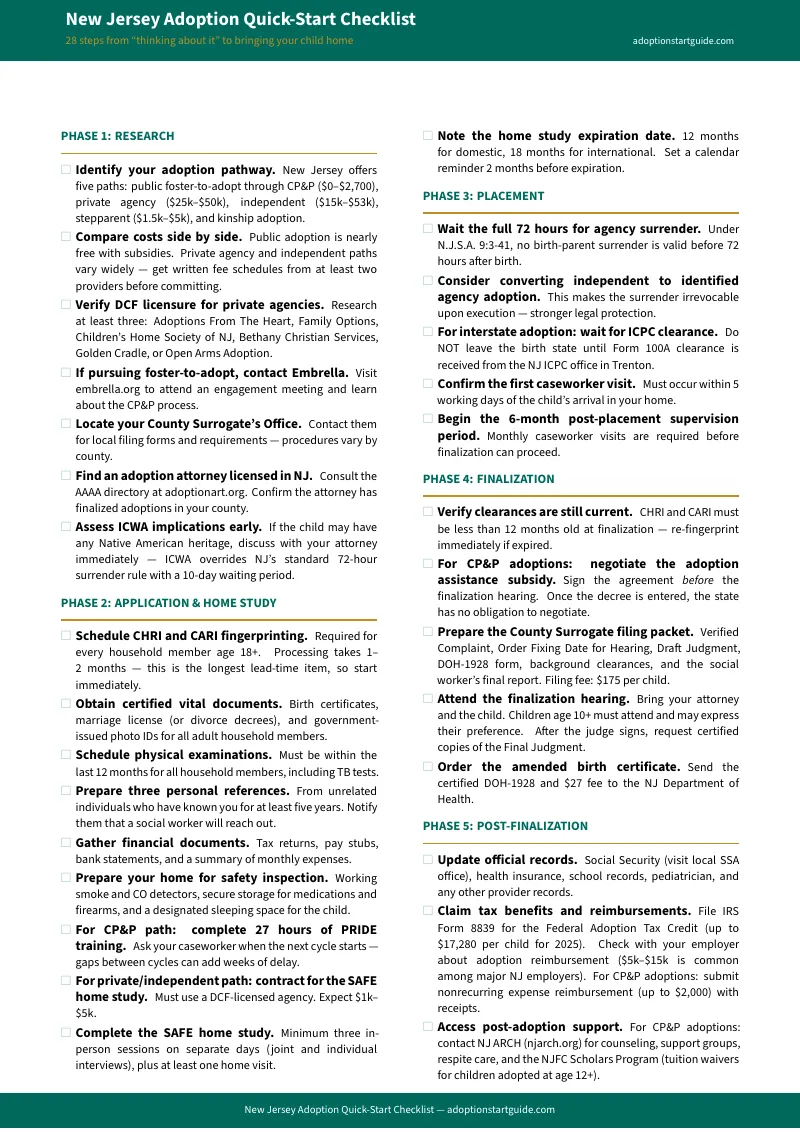
If you are early in your research, start with the free New Jersey Adoption Quick-Start Checklist. It covers the key action items for each phase of the adoption process — research, application, home study, placement, finalization, and post-finalization — in a one-page format you can print and work through. It includes the CHRI and CARI fingerprinting sequence, the county surrogate filing steps, and the Federal Adoption Tax Credit reminder. If you want the full guide with the six-pathway comparison, the N.J.S.A. Title 9 decoder, the surrender safe points, the SAFE home study walkthrough, the financial stacking strategy, and the county-by-county filing details, click the button in the sidebar.
— Less Than Fifteen Minutes of Attorney Time
A private adoption attorney in New Jersey bills $300 to $400 per hour. The first consultation typically runs 60 to 90 minutes, and a significant portion is spent on orientation — explaining how the NJ system works, what the pathways are, what the costs look like. That is valuable information, but it is $400 worth of billable time spent on foundational knowledge. This guide puts that foundation in your hands before the first meeting, so every minute of attorney time goes toward strategy specific to your case. The guide covers the six adoption pathways, the N.J.S.A. Title 9 statutes, the surrender safe points, the county surrogate filing system, the financial stacking strategy, the home study walkthrough, and the 2017 Birthright Act — for less than the cost of fifteen minutes in a family law office.
If the guide does not deliver what you need, reply to your download email at any time for a full refund. No forms. No justification required.