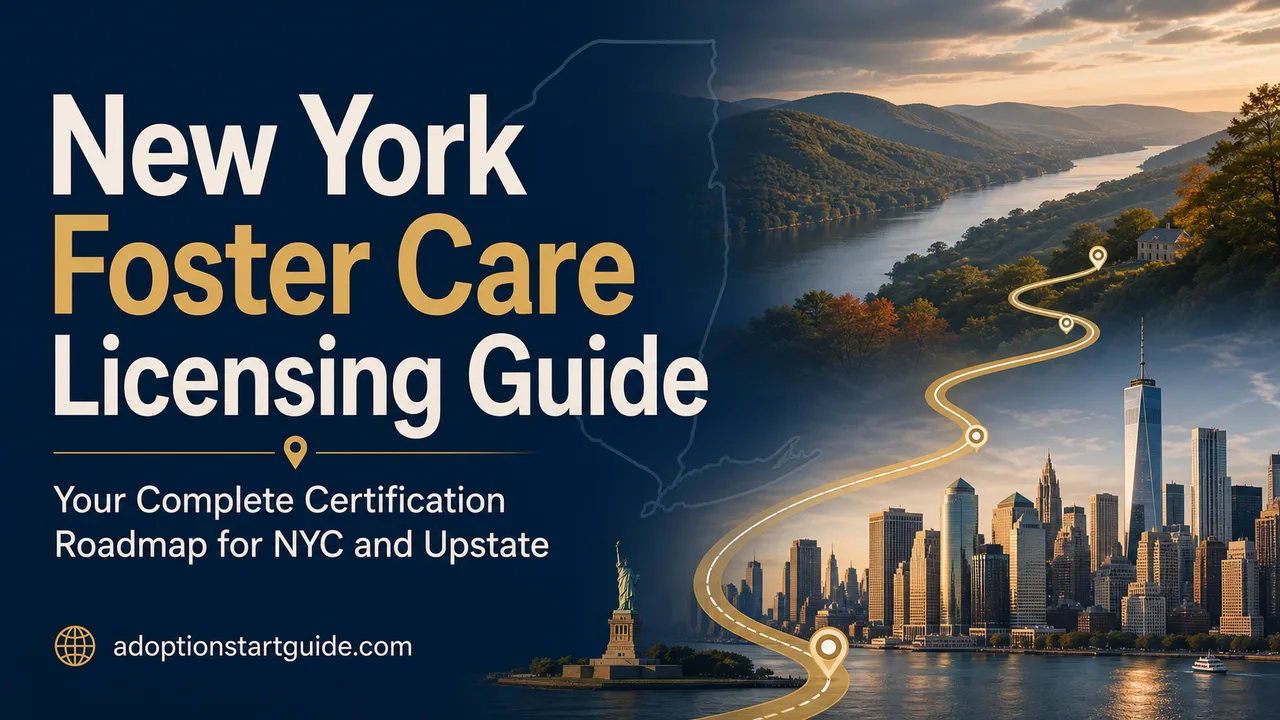
New York has 59 agencies that certify foster parents, and not one of them will tell you which door is right for yours.
You started on the OCFS website looking for a clear path. What you found was 18 NYCRR Part 443 — regulation language written for caseworkers, not families. It told you what a "certified foster boarding home" is. It did not tell you how to become one in plain English, or whether you should apply through ACS, one of the 30-plus Voluntary Foster Care Agencies in New York City, or your county's Department of Social Services upstate. That choice shapes every month of your experience — who trains you, how fast you're approved, what ages of children you'll be matched with, and whether you have a caseworker who returns your calls. Nobody lays out the tradeoffs. You're expected to pick a door blind.
So you called the WISH Line, or you went to an orientation at Good Shepherd or Forestdale or New York Foundling. What you got was a recruitment pitch. Inspiring stories. Statistics about the 12,800 children in care statewide. A general sense that fostering matters. What you didn't get was a timeline for your borough, a breakdown of what happens if your background check flags a dismissed charge from fifteen years ago, or an honest answer about whether your two-bedroom apartment in Brooklyn actually qualifies.
You went to Reddit. A foster parent in Texas told you that you need a separate bedroom for each child. That's Texas law — not New York's. In New York, 18 NYCRR 443.3 requires a separate bed, not a separate room. But you don't know that yet, because no single resource distinguishes between what's true in your state and what's true in someone else's. And the one thing every New York applicant discovers too late is that the system isn't one system. It's ACS running the five boroughs. It's 57 county DSS offices running everywhere else. It's 30-plus VFCAs each with their own intake process, training schedule, and caseworker-to-family ratio. Your experience in the Bronx will bear almost no resemblance to your experience in Cayuga County.
The 59-Agency Navigator: Your Operational Guide to New York Foster Care Certification
This guide is built for New York's foster care certification system — the real one, not the simplified version on recruitment brochures. Every chapter addresses the specific regulations under 18 NYCRR Part 443, the operational differences between ACS, VFCAs, and county DSS agencies, and the New York City housing realities that national guides have no framework for. It's not a repurposed handbook from another state. It's the layer between what OCFS publishes for professionals and what you actually need to know to get certified — in your borough, in your county, under the rules that apply right now.
What's inside
- ACS vs. VFCA vs. County DSS Pathway Comparison with 10 Agency Interview Questions — This is the single most consequential choice in the New York foster care process, and nobody gives you a neutral framework for making it. ACS direct certification in NYC means working with the city's own system — large-scale, sometimes slow, but with certain placement priorities. A VFCA like Good Shepherd, Forestdale, or New Alternatives for Children offers more specialized support and smaller caseloads, but each agency has its own training calendar, its own caseworker ratio, and its own waitlist. Upstate, your county DSS is the only option — but some counties run MAPP training twice a year and others run it quarterly. This chapter maps the tradeoffs by geography and gives you 10 questions to ask any agency before you sign their application, so you choose based on operational reality instead of whoever had the most polished orientation.
- Background Check Roadmap — SCR, DCJS, FBI, and the Clearances Nobody Mentions — Every adult in your household must clear five layers of screening before your home study can be finalized: the Statewide Central Register of Child Abuse and Maltreatment (SCR), the Division of Criminal Justice Services (DCJS), the FBI national fingerprint check, the Sex Offender Registry, and the Staff Exclusion List. If you have a household member with any history — even an old arrest that was dismissed or sealed — SSL § 378-a governs the safety assessment, and most applicants don't learn how the review process works until they're already inside it. This chapter walks you through each clearance layer, explains the presumptive disqualifiers versus discretionary factors, and shows you how to prepare your documentation before the fingerprinting appointment instead of scrambling after a flag you didn't expect.
- NTDC Training and NYC's TRIPP Requirement — New York replaced MAPP and GPS with the National Training and Development Curriculum (NTDC) in January 2025. The training hours, the curriculum content, and the competency framework all changed. If you're reading advice from 2024 or earlier, the training section is obsolete. In New York City, ACS additionally requires TRIPP (Training, Resources, Information, and Preparation for Parents) — a supplemental program that VFCAs and ACS direct each deliver on their own schedule. This chapter covers the current requirements, typical session counts, and how to plan around training calendars that may only align with your availability once per quarter.
- NYC Apartment Navigation — 18 NYCRR 443.3 and the Window Guard Rule — This is where national guides fail New York City applicants completely. Under 18 NYCRR 443.3, a foster child needs a separate bed in "adequate" sleeping space — not a separate bedroom. Many NYC foster parents are certified in one-bedroom and two-bedroom apartments. But the regulations also require compliance with the NYC Department of Health window guard mandate: approved guards on every window in any apartment where a child under 10 resides, with openings no greater than 4.5 inches. Your landlord is legally obligated to install them, but many don't until you know to file the annual notice. This chapter translates the actual space requirements into practical terms for apartment dwellers — what passes inspection, what doesn't, and how to handle a landlord who isn't cooperating.
- KinGAP Pathway — The 6-Month Rule, Emergency-to-Full Certification, and Subsidy Calculation — If you're a grandparent, aunt, uncle, or extended family member who took in a child during an emergency removal, you were likely "approved" on an expedited basis for up to 90 days. But temporary approval doesn't come with financial support that matches full certification. To access the Kinship Guardianship Assistance Program (KinGAP), the child must have been in your certified home for at least six consecutive months — and you must complete the full certification process during that window, not after. This chapter maps the transition from emergency approval to certified relative foster parent, explains how the KinGAP subsidy is calculated against the foster care maintenance rate, and identifies the deadlines that kinship caregivers miss most often.
- Financial Reality — Metro Board Rates, Upstate Rates, and the Costs Nobody Mentions at Orientation — New York's foster care board rates differ between New York City and the rest of the state, and they vary by the child's age. But the monthly maintenance payment is only part of the financial picture. This chapter breaks down the actual rates by region and age group, the clothing allowance schedule, childcare subsidies available to working foster parents, and the out-of-pocket costs that don't appear in any recruitment brochure — transportation for birth parent visitations across boroughs via the MTA, lost wages from Child and Family Team meetings scheduled during work hours, and the gap between what the system reimburses and what caregiving actually costs in a city where a MetroCard runs $34 a week.
- Home Study Pre-Audit Checklist — Room-by-Room Physical Inspection — The home study is the part of the process that generates the most anxiety, and most of that anxiety comes from not knowing what the inspector actually checks. This chapter is a room-by-room walkthrough of every physical requirement under 18 NYCRR 443.3 — working smoke detectors on every floor, carbon monoxide detectors, hot water temperature below 130°F, safe storage of medications and cleaning products, window guards in NYC, and the specific fire safety and egress requirements that apply to your building type. Walk your home with this chapter before the study, not after. The most common failures are things you can fix in an afternoon.
- Post-Certification Life — Placement Calls, Birth Parent Visitation, and Caseworker Visits — Certification is the beginning, not the finish line. This chapter covers what actually happens next: how placement calls work and how quickly you need to respond, the mandatory frequency of caseworker home visits, what birth parent visitation looks like in practice (including supervised visits at agency offices that may be across the borough from your apartment), and how to navigate the first 72 hours after a child is placed in your home. Most guides stop at certification. This one doesn't.
Printable standalone worksheets included
- Certification Timeline Tracker — Every milestone from initial inquiry through your certification letter, with fill-in date fields. Print it, update it after every agency contact, and always know where you stand in the process.
- Home Safety Inspection Checklist — Room-by-room walkthrough of every 18 NYCRR 443.3 requirement, including NYC-specific items like window guards. Walk your home with this before the inspector arrives.
- Document Organization Sheet — SCR clearance, DCJS fingerprint results, FBI check, medical forms, personal references, NTDC training certificates, CPR/first aid certification — every document you need, in the order you need it, with checkboxes.
- Financial Planning Worksheet — Monthly board rates by age group and region (NYC vs. upstate), clothing allowances, childcare subsidies, and hidden costs in one printable sheet. Take it to your household budget conversation.
Who this guide is for
- NYC apartment dwellers — You've been told you need a house to foster. You don't. Thousands of New York City foster parents are certified in apartments. But you do need to understand the specific space requirements, window guard mandates, and building-type safety rules that apply to your situation. If you live in a walk-up in Brooklyn or a high-rise in the Bronx, this guide translates 18 NYCRR 443.3 into practical terms for your actual home.
- Upstate families — Your county DSS is the only path, but how your county operates — training frequency, processing speed, caseworker availability — varies dramatically from Erie County to Cayuga County to Schenectady. This guide maps the upstate landscape so you know what to expect from your specific county before the first phone call.
- Kinship caregivers — A grandchild, niece, nephew, or family friend's child was removed and placed with you on an emergency basis. The child is already in your home. You need to move from temporary approval to full certification within the window, understand the 6-month KinGAP eligibility rule, and access the financial support that emergency-only approval doesn't provide.
- Applicants with background check concerns — You have something in your past — an old arrest, a dismissed charge, an investigation that went nowhere — and you're convinced it will disqualify you. SSL § 378-a doesn't work that way. The review process distinguishes between presumptive disqualifiers and discretionary factors. This guide explains the difference and how to prepare your documentation before it becomes an issue.
- Foster-to-adopt families — You're entering foster care with the hope of eventually providing a permanent home. In New York, certification clears you for both foster care and adoption — but the concurrent planning process, reunification timelines, and the emotional reality of supporting a child's potential return to their birth family require preparation that orientations don't cover.
Why the free resources aren't enough
The OCFS website publishes 18 NYCRR Part 443 — regulation language designed for county administrators and agency caseworkers, not applicants. It tells you the legal standards. It doesn't tell you which standards trip people up in practice, how the 59 certifying agencies differ, or what to do when your caseworker at a VFCA leaves mid-process and nobody picks up your file for three weeks.
ACS orientations and VFCA information sessions are recruitment events. They exist to inspire you to apply, not to prepare you to succeed. You'll hear about the children who need homes. You won't get a side-by-side comparison of that agency's caseload versus the one across the borough, or a realistic timeline for your neighborhood.
Reddit and Facebook groups provide emotional support, but an answer from a foster parent in Dallas about bedroom requirements will mislead you in Queens. New York's regulations are state-specific, and within the state, the NYC vs. upstate divide means advice from Rochester may not apply in Manhattan. Crowdsourced guidance is well-intentioned and frequently wrong for your situation.
Generic foster care planners on Etsy give you blank log pages for medical appointments and school records. They're organizational tools, not strategic ones. They don't know that New York replaced MAPP training in January 2025, that NYC requires window guards with 4.5-inch maximum openings, or that the KinGAP subsidy requires six consecutive months of certified placement before finalization. A $12 printable binder doesn't tell you which agency to choose or what the home inspector is looking for in your apartment.
The free Quick-Start Checklist
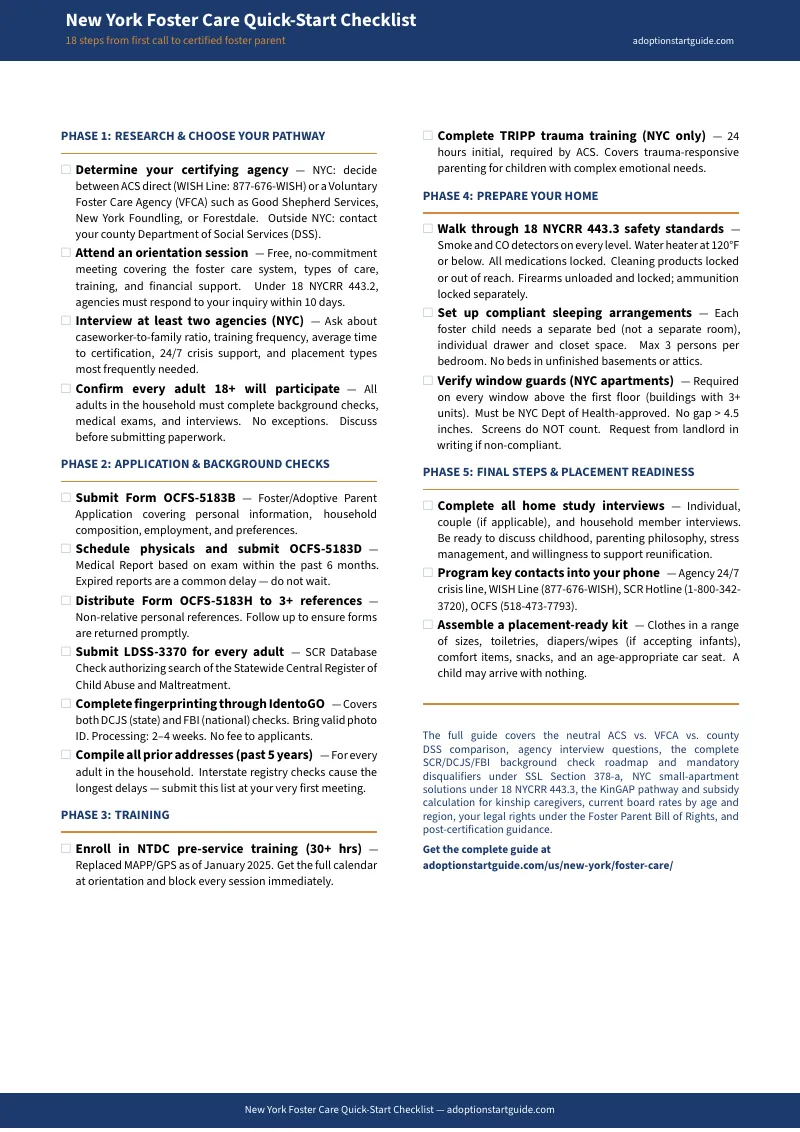
Download the New York Foster Care Quick-Start Checklist for a one-page overview of the certification process, from initial inquiry through your certification letter. Free, no commitment. If you want the full guide with the 59-Agency Navigator, background check roadmap, NYC apartment walkthrough, financial breakdown, and printable worksheets, click the button in the sidebar.
— less than one subway ride per chapter
The typical New York applicant spends months piecing together the certification process from OCFS regulations, agency websites, Reddit threads, and word of mouth — and still doesn't know whether they chose the right agency until they're months in. This guide distills the most critical decisions into a single weekend read. A home study failure because of missing window guards or improper medication storage delays your certification by months. One checklist prevents that. A background check flag you didn't prepare for burns weeks while you scramble for documentation you could have assembled in advance. One chapter prevents that.
If the guide doesn't deliver, reply to your download email at any time for a full refund. No forms. No justification required.